USAID
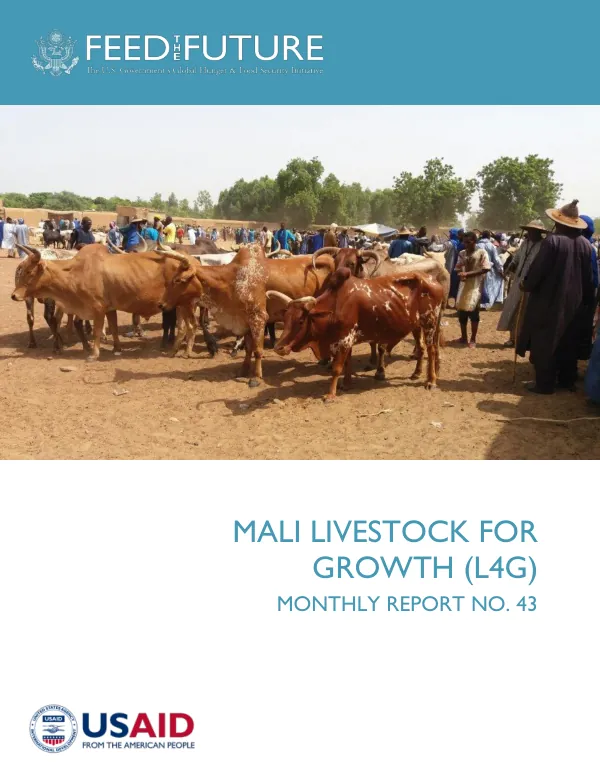
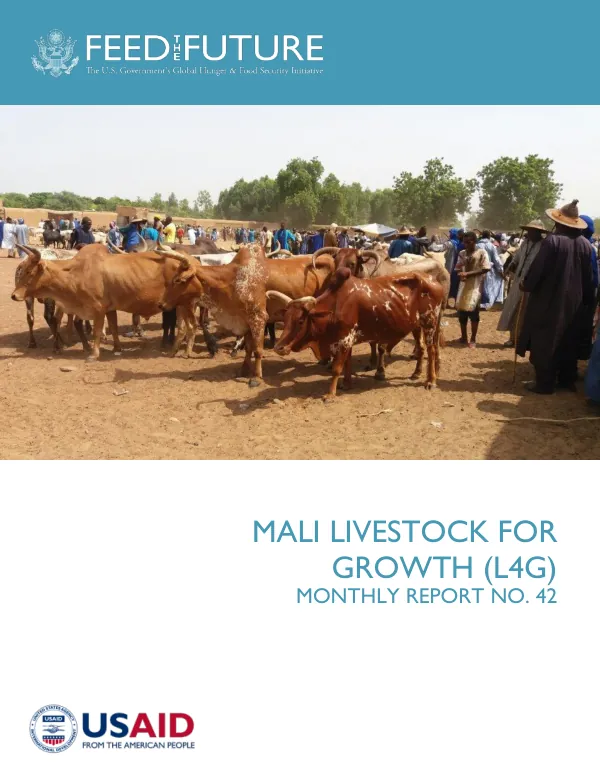
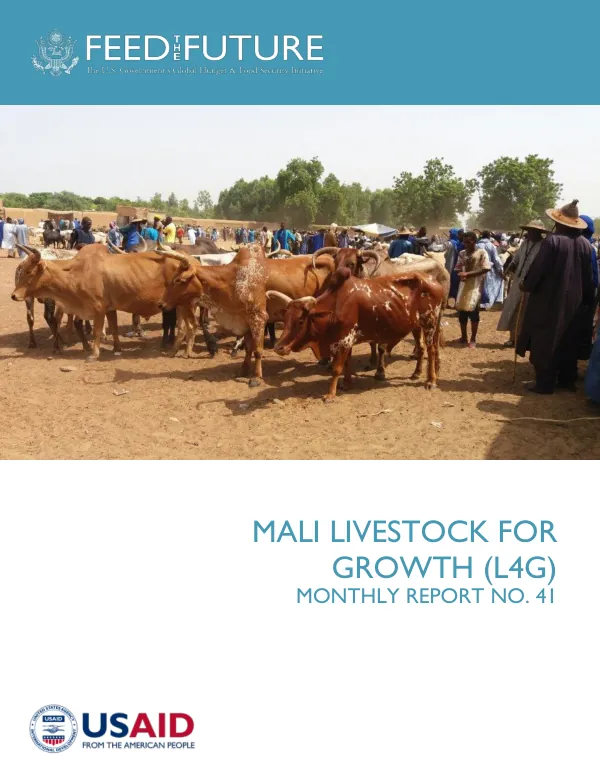
Mali Livestock for Growth (L4G) Monthly Report No. 41
The Mali Livestock for Growth (L4G) program is a USAID-funded initiative aimed at improving the livestock sector in Mali.
2018 · 38 pages
Sign in to readA free account is required to download.
Abstract
The program focuses on increasing animal production and access to technologies, as well as increasing livestock trade with reduced barriers. During the period from February 15th to March 15th, significant progress was made under each component or strategic objective. In Component IR1: Increased Animal Production and Access to Technologies, animal health activities were a major focus. A total of 523 cattle were vaccinated against pneumonia (PPCB), 23,338 cattle were vaccinated against cattle pasteurollosis, and 19,384 sheep/goats were vaccinated against small ruminant pasteurollosis. The three veterinarians based in Koro and Bankass achieved a combined gross margin of 3,303,640 CFA or $6,070 USD. Additionally, 681 cattle and 2,680 sheep/goats received de-worming and other treatments by the SVPP (Laya Togo) in Bankass. Seed reimbursement was also a key activity, with 375KG of groundnut ICGV 86024 seeds reimbursed by two PO's from Konio and Toumadiama in Djenné. In Bankass and Bandiagara, 608 KG of seeds were reimbursed by 35 PO's, including 20 KG of cowpea seeds, 110 KG of groundnut "flower 11" un-hulled seeds, and 478 KG of groundnut "flower 11" hulled seeds. Fodder production was another area of focus, with over 49,000 KG of fodder harvested or produced during the period. In Koro, 34 producers (27 women; 7 men) from 06 PO's produced 6,170 KG of groundnut and cowpea fodder, while in Bankass, 200 KG of hay treated with urea was produced by the Pissa Farmer Field School (FFS). In Goundam, 28,000 bundles worth 140,000 KG of Bourgou fodder were harvested by 7 L4G villages, while in Diré, 1,383 bundles worth 6,915 KG of Bourgou fodder were harvested by two PO's who sold 1,500 KG at 75,000 CFA or $150 USD. Production of Multi-nutritional licking blocks (MNLBs) was also a key activity, with 889 MNLBs produced by 20 PO's from Bandiagara, Bankass, Djenné, and Koro. Of these, 844 MNLBs were sold for 703,750 CFA or $1,408 USD. In Component IR2: Increased Livestock Trade with Reduced Barriers, trade transactions were a major focus. A total of 1,433 animals, comprising 209 cattle, 1,025 sheep, and 199 goats, were purchased by 81 PO's and 30 individuals in order to undertake fattening activities. The combined value of animals sold during the period from Diré, Djenné, Bankass, Goundam, Koro, Niafunké, and Mopti was estimated at 58,211,500 CFA or about $116,423 USD. Access to finance was also a key area of focus, with one PO from Koro receiving a 500,000 CFA ($1000) loan from Kondo Jigima (MFI). Additionally, one PO in Koro collected 93 bags of cowpea from members and intends using these as a collateral to receive a loan worth 2,278 500 CFA or $4, 557 USD. The program also focused on reducing trade barriers, with 35,500 FCFA or $71 USD imposed by the Police, Gendarmerie, and Douane in the form of irregular fees to the Koro's fatteners group. However, no particular incidents were reported during this period in the program's intervention areas. In Component IR1: Increased Animal Productivity, the program focused on enhancing technology development, dissemination, management, and innovation. A total of 43,247 animals were vaccinated by the three SVPPs (two in Bankass and one in Koro). The combined gross margin achieved by the three SVPPs was estimated at 3,303,640 CFA or $6,070 USD. Capacity building of the SVPPs was also a key area of focus, with Dr. Seydou Sidibe beginning his STTA regarding capacity reinforcement needs for the SVPPs. The STTA has produced a workplan and has already interacted with several L4G partners, including the DNSV, DNPIA, ILRI, staff L4G, DRSV, DRPIA, APESS, FOFBEV, and SVPP. Overall, the Mali Livestock for Growth (L4G) program made significant progress during the period from