USAID
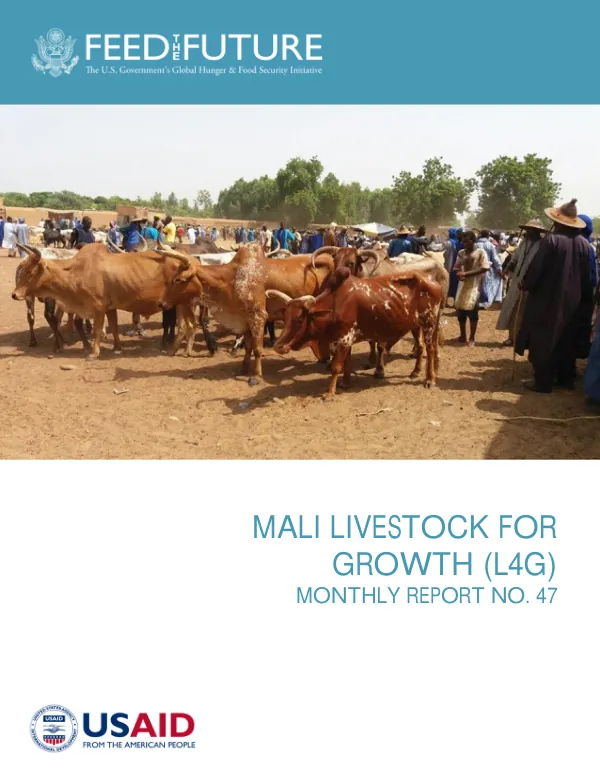
Mali Livestock for Growth (L4G) Monthly Report No. 47
The Mali Livestock for Growth (L4G) program aims to increase animal productivity and access to technologies, as well as promote increased domestic and export trade.
2018 · 15 pages
Sign in to readA free account is required to download.
Abstract
The program is implemented in several regions of Mali, including Mopti, Bankass, and Djenné. The program's main objective is to improve the livelihoods of livestock producers and traders through the development of sustainable livestock production systems. During the period under review, from August 15th to September 15th, the program made significant progress in various areas. In the component of increased animal productivity, the program focused on enhancing technology development, dissemination, management, and innovation. This included the modernization of animal health delivery systems, the development and dissemination of messages about good livestock management practices, and the improvement of livestock forage and animal feed production and supply. The program also continued to educate its clients about the production of the lick block, a nutritious feed supplement for livestock. Twenty-seven women from the OP Arré-Badjan in the village of Koigour were trained on the technique of manufacturing the licking block. Additionally, the program promoted improved technologies through training of actors on post-harvest techniques for improved fodder production. In the component of increased domestic and export trade, the program focused on strengthening market linkages and access, as well as reducing barriers to domestic and export trade. During this reporting period, eleven exporters from the Bankass district were able to export 63 cattle to Côte d'Ivoire, generating a total sale of 20,820,000 CFA, or 41,620 USD. The program also continued to face challenges, including insecurity in the Mopti region, which restricted movement and hindered the smooth running of activities. Despite these challenges, the program made significant progress in various areas, including the vaccination of 1,613 animals against Pasteurellosis, the training of 100 producers on good livestock management practices, and the distribution of 894 kg of seeds to 428 producers in 10 villages of Goundam. The program's next steps include monitoring of vaccination operations, supporting the SVPP in raising awareness among herders for vaccination and deworming of animals, and raising awareness of animal feeders to better adopt good animal health practices. The program will also continue to promote improved technologies and strengthen market linkages and access to support the growth of the livestock sector in Mali. The program's activities and progress are closely monitored and evaluated to ensure that the program is meeting its objectives and making a positive impact on the livelihoods of livestock producers and traders. The program's success will depend on the continued support of its partners and stakeholders, as well as the ability to adapt to the changing needs and challenges of the livestock sector in Mali. The program's geographic focus is on several regions of Mali, including Mopti, Bankass, and Djenné. The program's timeframes are monthly, with the current report covering the period from August 15th to September 15th. The program's recommendations include continued support for the program's activities and initiatives, as well as the provision of additional resources and funding to support the growth of the livestock sector in Mali. The program's implementation details include the provision of advisory support to farmers, the distribution of seeds and other inputs, and the training of producers on good livestock management practices. The program's methodology includes the use of Farmer Field Schools (FFS) to train producers on good livestock management practices, as well as the use of market research and analysis to identify opportunities for trade and market development. The program's key findings include the significant progress made in various areas, including the vaccination of 1,613 animals against Pasteurellosis, the training of 100 producers on good livestock management practices, and the distribution of 894 kg of seeds to 428 producers in 10 villages of Goundam. The program's conclusions include the need for continued support for the program's activities and initiatives, as well as the provision of additional resources and funding to support the growth of the livestock sector in Mali.