THE UNITED STATE CENTERS FOR DISEASE CONTROL AND PREVENTION
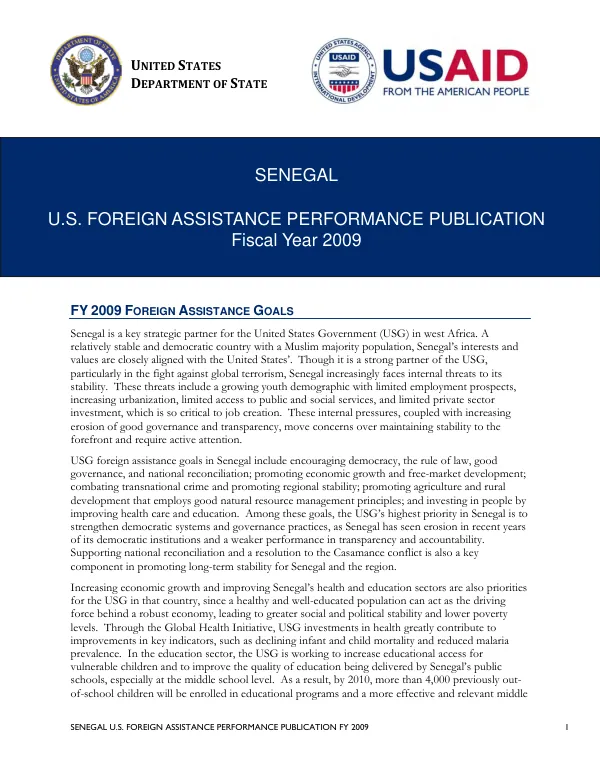
Mali U.S. Foreign Assistance Performance Publication FY 2009
The Government of Mali demonstrates a strong commitment to democracy, political tolerance, human rights, economic development, and responsible international engagement.
2009 · 5 pages
Sign in to readA free account is required to download.
Abstract
However, institutions in Mali are still fragile, and the country remains at the bottom of the Human Development Index, primarily due to a lack of access to quality health care and education services. Significant security challenges exist in the north of the country. United States Government (USG) assistance to Mali focuses on strengthening and consolidating Mali's institutions, helping Mali promote rapid, sustainable economic growth, addressing key health threats, supporting educational development, and ensuring Mali's continued cooperation in combating extremism through its participation in the Trans-Sahara Counter-Terrorism Partnership. In the democracy and governance sector, USG assistance aims to help consolidate Mali's decentralization process by fostering transparency and accountability, promoting peace and stability in the northern regions, and reinforcing local development by strengthening the capacity of civil society. USG democracy and governance assistance directly supports the Government of Mali's efforts to transfer responsibilities and financial resources to the local level. The Shared Governance program addresses the issue of communities in Mali lacking the skills and competencies to make programming decisions effectively and manage social service delivery. The program provides practical, hands-on training to mayors, communal council members, and civil society organizations, enabling them to design and manage the delivery of health, education, agricultural production, water, and other services to constituents. In the health sector, USG assistance focuses on increasing maternal and child health, preventing malaria, and expanding access to family planning and reproductive health. Mali has some of the greatest health challenges in the world, with a maternal mortality rate of 464 per 100,000 live births, a child mortality rate of 191 per 1,000 live births, and a total fertility rate of 6.6 births per woman. USG assistance has helped introduce active management of the third stage of labor and essential newborn care across the country, and the number of mothers and newborns benefiting from these life-saving interventions increased markedly. USG assistance has also helped to improve immunization coverage among children under one year of age, with virtually universal coverage achieved. Over 5,000,000 doses of vitamin A were administered to children under five years old during two "nutritional weeks." The prevention of diarrheal disease was enhanced through U.S. support to the National Hand Washing Day, community-based health education, and the launch of the socially marketed "Aquatab" point-of-use water treatment, which purified more than 19 million liters of water. In support of Mali's April 2009 municipal elections, the U.S. Agency for International Development (USAID) implemented a program to enhance Malian women's participation in the electoral process. The program's specific objectives were to increase the number of women on party candidate lists and mobilize women to vote in upcoming municipal elections. Activities included raising awareness of the importance of women's political participation in Mali's local elections by organizing three panel discussions among civil society representatives and government officials in the Malian regions of Sikasso, Mopti, and Gao. The USG supported peace and security programs that assisted the Government of Mali in improving its operational and tactical capabilities to confront and respond to threats of terrorism. The training of Mali's security forces continues a long, incremental process of enhancing and sustaining Mali's capacity to take strong, effective, and decisive measures to eliminate terrorist networks and prevent terrorist attacks within Mali. Military equipment provided to the Government of Mali will directly assist in efforts to improve peace and security in the region.