USAID
USAID/Mali ERSA Performance Monitoring and Evaluation Plan
The ERSA project in Mali aims to increase equitable access to learning opportunities for out-of-school children and youth in targeted areas in the north.
2020 · 131 pages
Sign in to readA free account is required to download.
Abstract
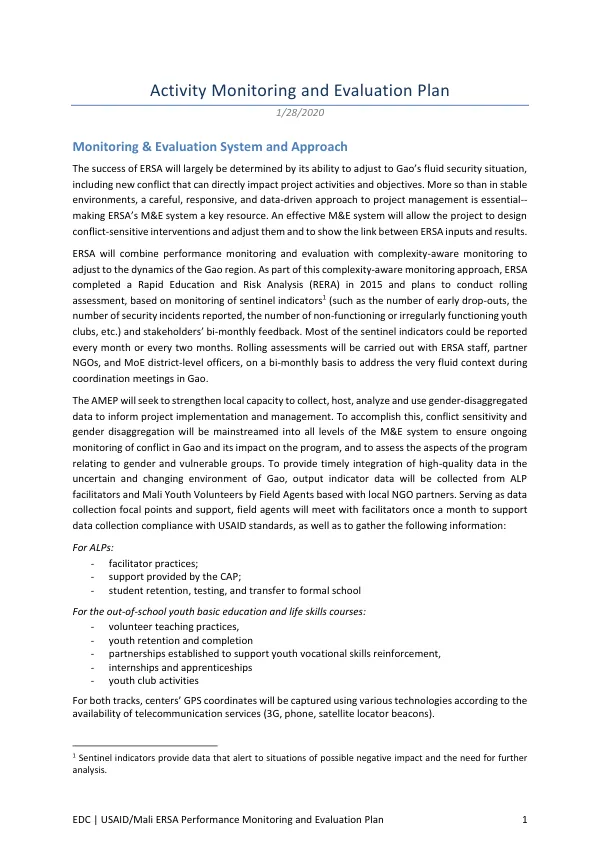
The project's underlying theory of change is that local education management systems, communities, and teachers can develop and effectively manage functional, inclusive, gender-equitable educational and vocational systems that integrate peace building and life skills, thereby preparing children and youth to contribute to the social and economic stability of the region. The project goal is supported by three intermediate results (IRs): IR 1, Expanded access to literacy and numeracy, and to life skills opportunities for out-of-school children 9-14 years of age; IR 2, Improved basic literacy and numeracy, and life skills for out-of-school youth 15-24 years of age in pursuit of vocational training; and IR 3, Improved vocational skills, entrepreneurship capabilities, and employability of out-of-school youth. The project will track progress towards these IRs through a range of indicators, including the number of parents or community members trained to support children's education, the number of accredited ALP centers established, and the number of learners reached in reading programs at the primary level. The project will also collect data on the effectiveness of ALP facilitators, including their instructional practices, support provided by the Community Action Plan (CAP), and student retention, testing, and transfer to formal school. Additionally, the project will track the number of facilitators trained in high-quality, gender and conflict-sensitive basic skills curriculum, and the percentage of ALP facilitators demonstrating good instructional practices, including gender and conflict-sensitive practices and attitudes. To support the project's monitoring and evaluation efforts, a Rapid Education and Risk Analysis (RERA) was conducted in 2015, and a rolling assessment approach will be used to monitor sentinel indicators, such as the number of early drop-outs, security incidents reported, and non-functioning or irregularly functioning youth clubs. The project will also collect data on the number of volunteers trained in high-quality, gender and conflict-sensitive basic skills curriculum and materials, and the percentage of volunteers demonstrating good instructional practices, including gender and conflict-sensitive practices and attitudes. The project's data collection efforts will be organized by type of program, with separate efforts for the ALP track and out-of-school youth programs. For the ALP track, the project will monitor ALP facilitator teaching practices, and for the out-of-school youth programs, the project will track the number of volunteers trained, the number of youth completing basic education and life skills programs, and the percentage of youth demonstrating improved skills in basic education and life skills. The project's overall rollout of ALP and out-of-school youth cohorts will allow for the planning of evaluation activities, and the project will track progress towards its IRs through a range of indicators. The project's principal data collection efforts will be organized by type of program, with separate efforts for the ALP track and out-of-school youth programs.