USAID DEC
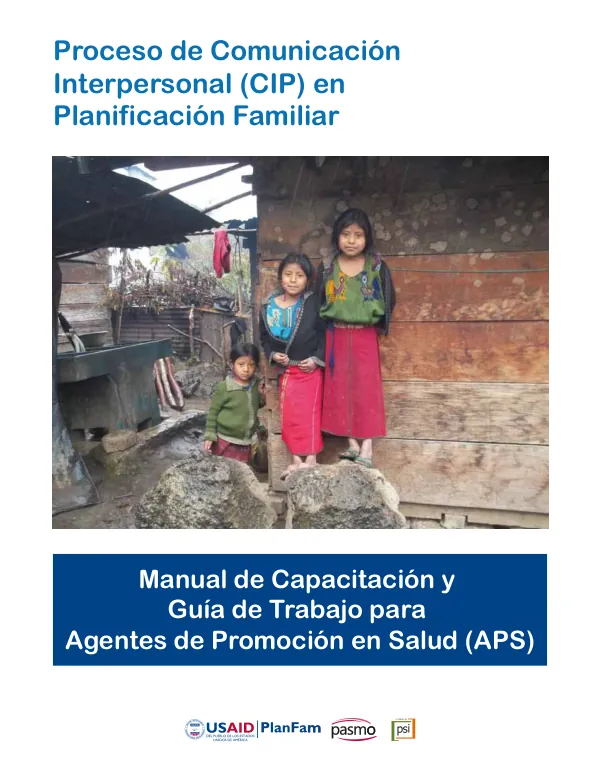
Manual de Capacitación para Agentes de Promoción en Salud : Proceso de Comunicación Interpersonal en Planificación Familiar
Sign inUSAID
Manual de Capacitación para Agentes de Promoción en Salud : Proceso de Comunicación Interpersonal en Planificación Familiar
The manual for Agents of Health Promotion (APS) focuses on the process of Interpersonal Communication (CIP) in Family Planning.
2013 · 69 pages
Sign in to readA free account is required to download.
Abstract
The CIP is defined as the face-to-face interaction with individuals or groups, providing clear and simple messages to promote behavior change and healthier conduct. PSI/PASMO utilizes this strategy since the beginning of its activities. The APS are responsible for sharing information and delivering health messages on specific topics to individuals or groups, using the CIP process. This manual reviews the CIP process in general, specifically applied to the topic of Family Planning. The main topics covered include: Characteristics of a good APS, such as being committed to society, trustworthy, well-formed, and respectful of community members. APS must also be recognized as leaders, multipliers of the benefits of family planning, and solidary with the health of others. The APS must be able to communicate effectively, using clear, simple, and consistent messages that adapt to the needs of the person or group they work with. They must also be able to listen without judging and be free of prejudices. The manual aims to provide a concrete and easy-to-use tool for training APS, as well as a support instrument for trainers. It describes the different contents and steps of learning to manage the CIP process effectively, enabling APS to achieve healthier behavior changes. The APS work with women and men in reproductive age (15 to 49 years old) living in priority areas of Guatemala and the health project. Their work aims to educate and provide personalized, adequate, and consistent information to change people's way of thinking and adopt healthier behaviors. The APS must speak the local language and use clear, simple, and consistent messages that adapt to the needs of the person or group they work with. They must also be able to work with small and homogeneous groups. The manual provides a series of didactic elements to facilitate teaching and learning, including a "Guide for Work for the Agent of Health Promotion," "Anexos" with forms used by APS, and criteria for selection and responsibilities of an APS. The manual was developed with the objective of training APS on the CIP process in general, and particularly applied to the topic of Family Planning. It serves as a concrete and easy-to-use tool for training APS, as well as a support instrument for trainers. The APS must be able to work in a team, be organized and punctual, and have a plan for their work. They must also be able to evaluate their work and make adjustments as needed. The manual provides a framework for APS to work effectively, using the CIP process to promote behavior change and healthier conduct. It aims to provide a concrete and easy-to-use tool for training APS, as well as a support instrument for trainers. The APS must be able to work in a variety of settings, including community centers, schools, and health facilities. They must also be able to work with a variety of stakeholders, including community leaders, health workers, and government officials. The manual provides a series of tools and resources for APS to use in their work, including a guide for work, anexos, and criteria for selection and responsibilities of an APS. It also provides a framework for APS to evaluate their work and make adjustments as needed.