USAID DEC
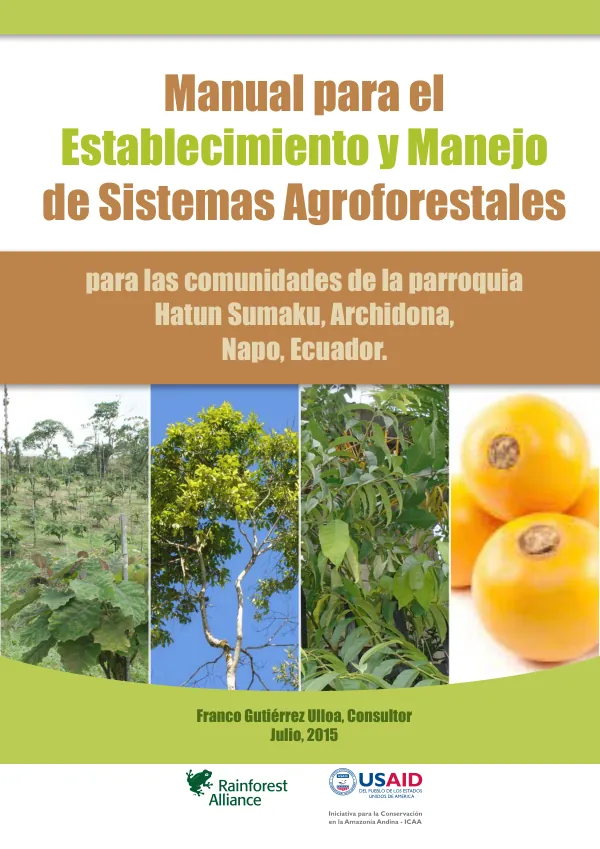
Manual para el establecimiento y manejo de sistemas agroforestales para las comunidades de la parroquia Hatun Sumaku
Sign inUSAID DEC
Manual para el establecimiento y manejo de sistemas agroforestales para las comunidades de la parroquia Hatun Sumaku
The Parroquia Hatun Sumaku is located in the interior of the Cantón Archidona, Provincia de Napo, in the vía Hollín-Loreto.
2015 · 11 pages
Sign in to readA free account is required to download.
Abstract
The majority of its area is within the Bosque Protector "Cerro Sumaco y Cuenca Alta del Río Suno," occupying 74% of the parroquial area. It is part of the Zona de Amortiguamiento del Parque Nacional Sumaco Napo-Galeras. The region has a mean annual temperature of 20.2°C, a mean annual precipitation of 4,222 mm, a relative humidity of 88%, and a heliofanía of 1,051.5 hours per year. According to the Holdridge classification, most of the area belongs to the zona de vida bosque pluvial Pre-Montano (bp-PM) and the bioclimatic classification Lluvioso Sub-Tropical (L-ST). The fisiografía of the soil is a combination of mesas and quebradas. The mother rock is sedimentary under a layer of ceniza. The predominant soil is HYDRANDEPTS, which is loose and deep, often humid and spongy with a jabonoso texture, a pardo amarillento color, and low fertility, often with toxic aluminum. According to the Mapa de Uso Potencial del Suelo, 75% of the area is recommended for integrated agroforestry management, with intensive agrosilvicolas practices, silvopastoral management in small extensions, and forest management in accessible areas. The predominant crop is naranjilla, with varieties such as híbrida Puyo and INIAP Palora, associated with scattered trees, mainly laurel (Cordia alliodora) and cedro (Cedrela odorata and Cedrela montana). The objective of this work is to develop a manual for the communities of the Parroquia Hatun Sumaku for the establishment and management of agroforestry systems, using good agro-silvicultural practices. Agrosilvicultura is a system where trees are combined with agricultural crops in the same area. It is the association of trees distributed uniformly in areas with crops, trying not to interfere with the production of the agricultural component. The benefits of agrosilvicultura include protecting crops from radiation and winds, adding organic matter to the soil, and capturing carbon. The advantages of associating crops with trees include: - Protecting crops from radiation and winds - Adding organic matter to the soil - Protecting crops from animal and human damage - Protecting crops from erosion - Improving nutrient and water use - Capturing carbon - Producing wood, firewood, and fruits in the same area - Producing more wood near populations However, there are also some disadvantages to associating crops with trees, including: - Reducing the available space for the farmer - Dificultating agricultural labor due to tree roots - Competing with crops for water and nutrients - Decreasing crop production - Potentially hosting pests and diseases that harm crops - Potentially harming crops when trees are harvested The manual aims to provide guidance on the establishment and management of agroforestry systems in the Parroquia Hatun Sumaku, using good agro-silvicultural practices. It will cover topics such as the definition and benefits of agrosilvicultura, the advantages and disadvantages of associating crops with trees, and the establishment and management of agroforestry systems.