USAID DEC
Manual to Support the Calculation of Civil Reparation in Crimes against the Public Administration
Sign inUSAID DEC
Manual to Support the Calculation of Civil Reparation in Crimes against the Public Administration
The calculation of civil reparation in crimes against the public administration is a complex issue that arises from the infringement of fundamental rights of citizens as contained in the constitution.
2014 · 2 pages
Sign in to readA free account is required to download.
Abstract
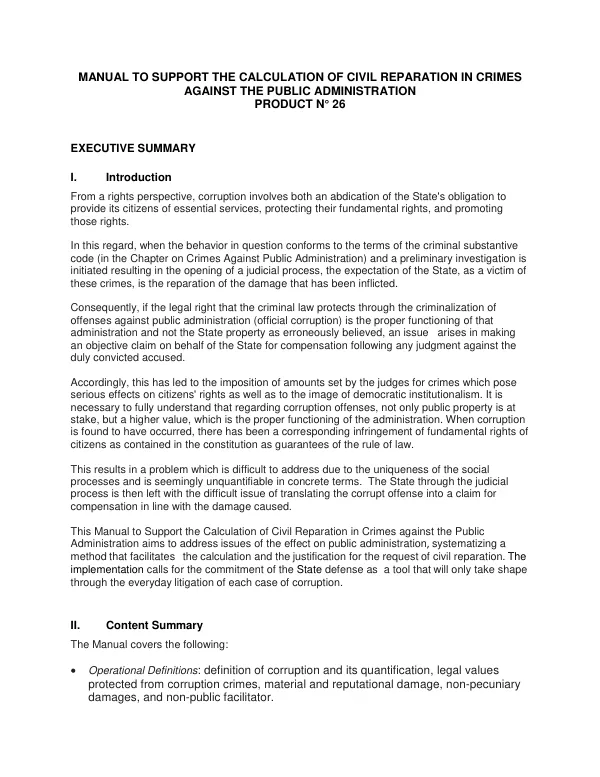
Corruption offenses not only affect public property but also the proper functioning of the administration, which is a higher value. When corruption is found to have occurred, the State is left with the difficult issue of translating the corrupt offense into a claim for compensation in line with the damage caused. The State's obligation to provide its citizens with essential services and protect their fundamental rights is abdicated when corruption occurs. This results in serious social consequences related to government property and violation of institutional rights and equal access by all. Corruption generates material and reputational damage, as well as non-pecuniary damages, which negatively affect society. The calculation of material and reputational damage involves determining consequential damages, which refer to the actual cash assets and loss of quantifiable value suffered by the State. This includes loss of profits, which is the income that the State has failed to receive. The calculation of non-pecuniary damages involves damage related to elements that are unquantifiable and negatively affect society. The Manual to Support the Calculation of Civil Reparation in Crimes against the Public Administration aims to address these issues by systematizing a method that facilitates the calculation and justification for the request of civil reparation. The implementation of this method requires the commitment of the State defense as a tool that will take shape through the everyday litigation of each case of corruption. The manual covers operational definitions, including the definition of corruption and its quantification, legal values protected from corruption crimes, material and reputational damage, non-pecuniary damages, and non-public facilitator. It also provides a description of the method to determine the civil reparation, including the calculation of material and reputational damage and non-pecuniary damages. Special cases are also addressed, which involve damages to the institutional image that do not affect the State's assets. The manual is based on the analysis of various specialists on the levels of corruption and its effect on society. It aims to provide a comprehensive approach to the calculation of civil reparation in crimes against the public administration, taking into account the complex social processes involved. The manual is intended to be a tool for the State defense in the everyday litigation of each case of corruption, facilitating the calculation and justification for the request of civil reparation.
Related documents