USAID DEC
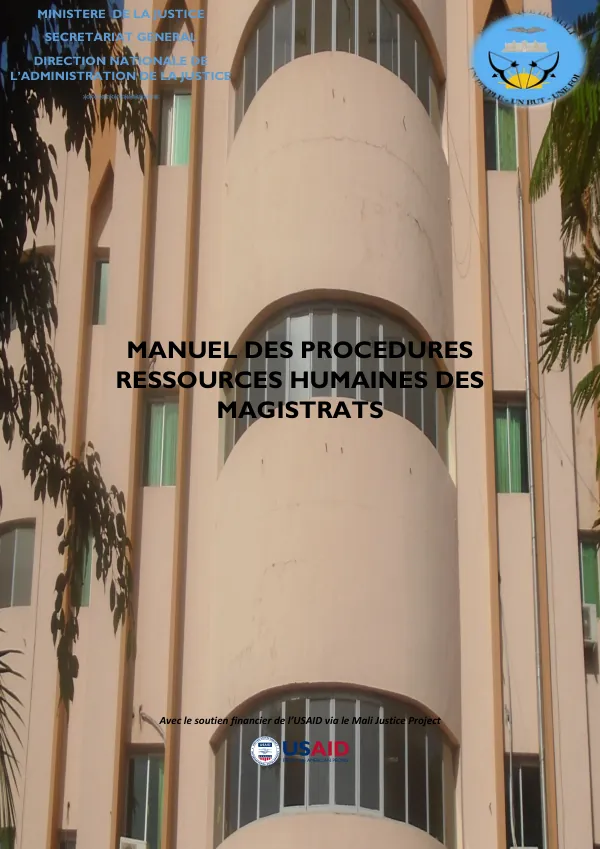
Manuel des procédures Ressources humaines des magistrats
The Mali Justice Project is a program supported by the United States Agency for International Development (USAID) through the Mali Justice Project.
2020 · 62 pages
Sign in to readA free account is required to download.
Abstract
The project aims to strengthen the administration of justice in Mali by improving the management of human resources within the judiciary. The project focuses on the career development and remuneration of magistrates in Mali. The career development of magistrates is governed by a set of rules and regulations outlined in the Manuel des Procédures. The rules cover various aspects of a magistrate's career, including recruitment, training, promotion, and remuneration. Recruitment of magistrates is a critical aspect of the project. The recruitment process involves a competitive examination, which is organized by the Direction Nationale de l'Administration de la Justice (DNAJ). The examination is designed to assess the candidates' knowledge, skills, and abilities. The results of the examination are used to select the most suitable candidates for appointment as magistrates. Once appointed, magistrates undergo a period of initial training and integration. The training program is designed to equip magistrates with the necessary skills and knowledge to perform their duties effectively. The program includes a comprehensive curriculum that covers various aspects of the judiciary, including law, procedure, and ethics. Magistrates are entitled to various benefits and allowances, including a salary, indemnity for responsibility and representation, and indemnity for water, electricity, and telephone. They are also entitled to a prime de sujétion for risk and an indemnity for judicature. In addition, magistrates are entitled to a security allowance and a housing allowance. The project also focuses on the promotion and career advancement of magistrates. Magistrates can be promoted to higher grades and positions based on their performance and experience. The promotion process is governed by a set of rules and regulations that outline the conditions for promotion, including the requirements for advancement to a higher grade, position, or category. The project also provides for the continuous training and development of magistrates. The training program is designed to equip magistrates with the necessary skills and knowledge to perform their duties effectively. The program includes a comprehensive curriculum that covers various aspects of the judiciary, including law, procedure, and ethics. In addition to the career development and remuneration of magistrates, the project also focuses on the management of human resources within the judiciary. The project aims to improve the efficiency and effectiveness of the judiciary by streamlining the management of human resources. The project includes a range of activities, including the development of a human resources management system, the establishment of a training program for human resources managers, and the provision of technical assistance to the judiciary. The project has a number of key stakeholders, including the Ministry of Justice, the Direction Nationale de l'Administration de la Justice, and the magistrates themselves. The project is implemented in collaboration with these stakeholders, who provide input and guidance on the project's activities and outcomes. The project has a number of benefits, including the improvement of the administration of justice in Mali, the enhancement of the career development and remuneration of magistrates, and the improvement of the management of human resources within the judiciary. The project is expected to have a positive impact on the judiciary and the administration of justice in Mali, and to contribute to the development of a more efficient and effective justice system.
Related documents