USDA
MAP 27: Soil Types in Northern Ghana
The Northern Region of Ghana is characterized by a diverse range of soil types, which play a crucial role in agricultural development.
2011 · 1 pages
Sign in to readA free account is required to download.
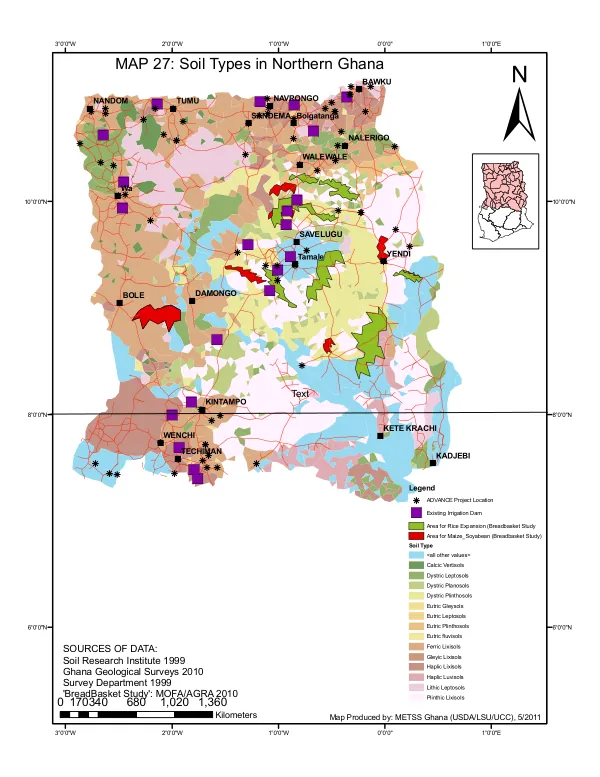
Abstract
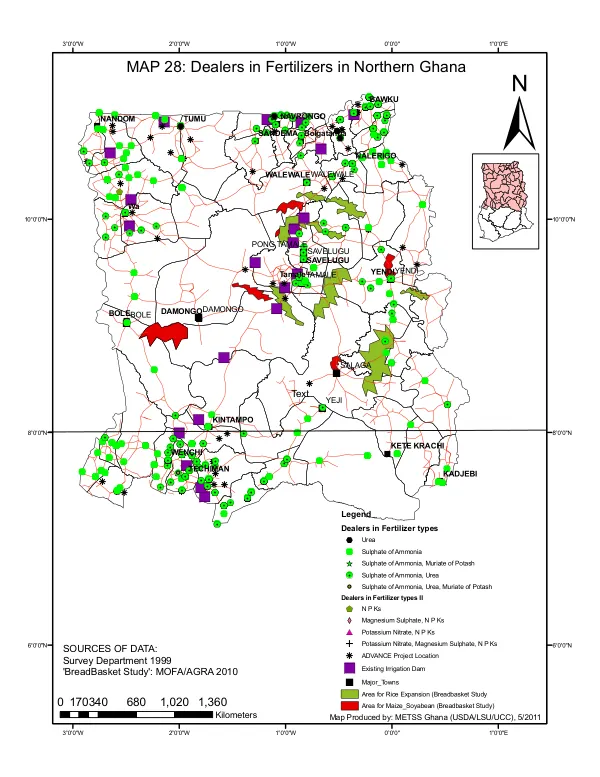
The region's soil types are primarily classified into several categories, including Calcic Vertisols, Dystric Leptosols, Dystric Planosols, and Eutric Gleysols. These soil types are found in various locations throughout the region, including the districts of Tamale, Wench, and Bolgatanga. The ADVANCE Project Location, which spans across several districts in the Northern Region, features a mix of soil types. The project area includes existing irrigation dams, areas for rice expansion, and areas for maize and soybean cultivation. The soil types in this region are primarily composed of Calcic Vertisols, Dystric Leptosols, and Eutric Gleysols. These soil types are suitable for a variety of crops, including maize, soybeans, and rice. The region's soil types are influenced by its geographical location, with the equator passing through the Northern Region. The region's latitude ranges from 8°0'0"N to 10°0'0"N, and its longitude ranges from 0°0'0"W to 3°0'0"W. The region's elevation varies, with some areas reaching up to 1,360 meters above sea level. The region's climate is characterized by a tropical savanna climate, with two distinct seasons: a wet season and a dry season. The region's soil types have significant implications for agricultural development. The Calcic Vertisols, for example, are suitable for maize and soybean cultivation, while the Dystric Leptosols are suitable for rice cultivation. The Eutric Gleysols, on the other hand, are suitable for a variety of crops, including maize, soybeans, and rice. Understanding the region's soil types is essential for developing effective agricultural strategies and improving crop yields. The Breadbasket Study, conducted by the Ministry of Food and Agriculture (MOFA) and the Alliance for a Green Revolution in Africa (AGRA), identified several areas in the Northern Region as suitable for rice expansion. These areas include the districts of Tamale, Wench, and Bolgatanga. The study also identified areas suitable for maize and soybean cultivation, including the districts of Tamale, Wench, and Bolgatanga. The study's findings have significant implications for agricultural development in the region.