USDA
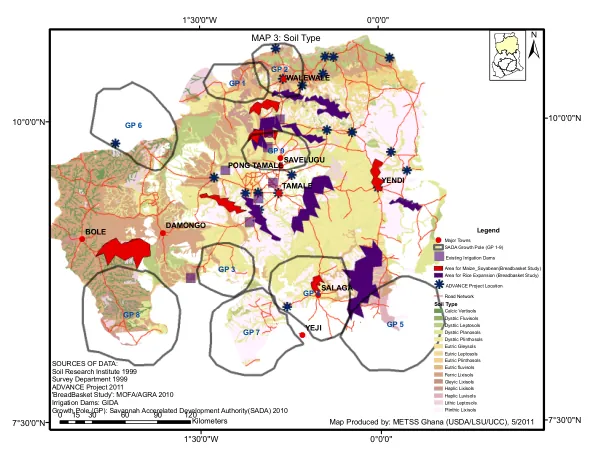
Map Produced by: METSS Ghana (USDA/LSU/UCC), 5/2011
The Savannah Accelerated Development Authority (SADA) Growth Pole (GP) 1-9 are located in the Northern Region of Ghana.
2011 · 1 pages
Sign in to readA free account is required to download.
Abstract
These growth poles are situated in the districts of Bole, Yendi, Yendi, Tamale, Salaga, Damongo, Walewale, Savelugu, and Pong Tamale. The geographic coordinates of these growth poles range from 0°0'0" to 10°0'0"N latitude and 1°30'0"W to 7°30'0"W longitude. The map produced by METSS Ghana, a collaborative effort between the USDA, LSU, and UCC, in 2011, highlights the location of these growth poles, existing irrigation dams, and areas suitable for maize-soybean and rice expansion. The map also displays the road network, soil types, and other relevant information. The soil types in the region include Calcic Vertisols, Dystric Fluvisols, Dystric Leptosols, Dystric Planosols, Dystric Plinthosols, Eutric Gleysols, Eutric Leptosols, Eutric Plinthosols, Eutric Fluvisols, Ferric Lixisols, Gleyic Lixisols, Haplic Lixisols, Haplic Luvisols, Lithic Leptosols, and Plinthic Lixisols. The data sources for the map include the Soil Research Institute (1999), Survey Department (1999), ADVANCE Project (2011), the BreadBasket Study by MOFA/AGRA (2010), and the Irrigation Dams data from GIDA. The map is an essential tool for understanding the geographic context and soil types in the region, which is crucial for agricultural development and planning. The ADVANCE Project, which is located in the region, aims to promote agricultural development and improve the livelihoods of smallholder farmers. The project focuses on improving soil fertility, increasing crop yields, and enhancing market access for farmers. The project's location and activities are closely tied to the growth poles and other development initiatives in the region. The growth poles, which are designated by the Savannah Accelerated Development Authority (SADA), are strategic locations for economic development and growth. They are designed to promote economic growth, create jobs, and improve the standard of living for the local population. The growth poles are located in areas with high potential for agricultural development, and they are expected to play a key role in the region's economic growth and development.