USAID DEC
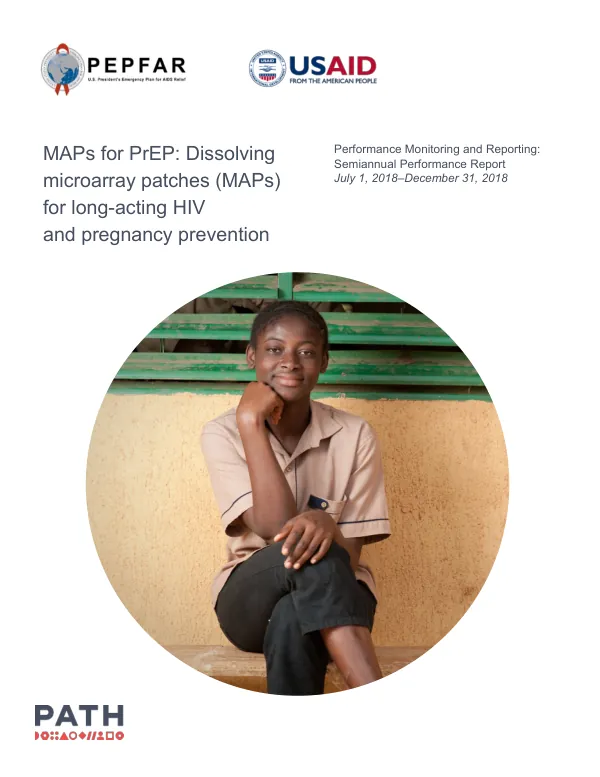
MAPs for PrEP: Dissolving microarray patches for long-acting HIV and pregnancy prevention
Sign inPATH
MAPs for PrEP: Dissolving microarray patches for long-acting HIV and pregnancy prevention
The MAPs for PrEP project aims to advance the development of dissolving microarray patches (MAPs) for long-acting HIV and pregnancy prevention.
2018 · 18 pages
Sign in to readA free account is required to download.
Abstract
The project is funded by the United States Agency for International Development (USAID) through the President's Emergency Plan for AIDS Relief (PEPFAR). PATH, in collaboration with Queen's University Belfast (QUB), is leading the project to develop a dissolving MAP platform containing a high-dosage formulation of solid nanoparticles of long-acting rilpivirine, an antiretroviral medication (ARV) under investigation as an HIV PrEP agent. The project's primary objective is to develop a dissolving MAP for delivery of an ARV for long-acting HIV pre-exposure prophylaxis (PrEP) to the point of phase 1 clinical readiness. To achieve this, the project team is working on several specific aims and related activities. These include establishing an agreement with a pharmaceutical company to obtain an ARV, advancing preclinical development of an ARV MAP, evaluating the acceptability of an ARV MAP for HIV prevention, and establishing the product development pathway for MAPs. During the first six months of the project, the team focused on startup activities, including establishing agreements with partners, identifying individuals to serve on the six-person scientific Project Advisory Committee (PAC), and obtaining conditional commitments for PAC membership. The team also conducted a landscape of ARVs to identify potential substitutes for cabotegravir (CAB) and completed a draft target product profile (TPP) document that defines minimum and optimal targets for parameters such as safety, efficacy, dosage, and stability for an ARV and MPT MAP. The project team is also exploring the potential of a segmented dissolving MPT MAP for delivery of both an ARV for long-acting HIV PrEP and a hormonal contraceptive for pregnancy prevention. This involves advancing proof-of-concept development of a contraceptive MAP to enable an MPT MAP. The team has initiated work on this aim by compiling a short-list of qualitative research organizations that could conduct usability evaluations in Kenya, South Africa, and Uganda. Women and adolescents in low- and middle-income countries are at greatest risk of HIV infection and unintended pregnancy and are in need of acceptable products that provide both long-acting protection against HIV and contraception. Microarray patches (MAPs) can be an easy-to-use and discreet delivery technology category, which could improve adherence to HIV PrEP and improve access to long-acting contraceptives. The MAP technology is safe, effective, stable, has an established, scalable manufacturing process, and is in early-stage clinical testing for vaccines and late-stage clinical testing for delivery of other drugs. The project team has developed a dissolving MAP platform containing a high-dosage formulation of solid nanoparticles of long-acting rilpivirine, an ARV under investigation as an HIV PrEP agent. Once the MAP for transdermal delivery is applied, the microneedles (microarray projections) dissolve, depositing drug nanoparticles into the skin. The patch is removed soon after application, and the drug is released slowly from the nanoparticles over a period of up to three months. Preclinical pharmacokinetic data found sustained drug concentrations in plasma and vaginal tissue, thus demonstrating the feasibility of MAP delivery of a long-acting ARV. The same approach could be applied to provide a hormonal contraceptive as well, to generate a discreet, long-acting multipurpose prevention technology (MPT).