LOCAL CIVIL SOCIETY ORGANIZATIONS
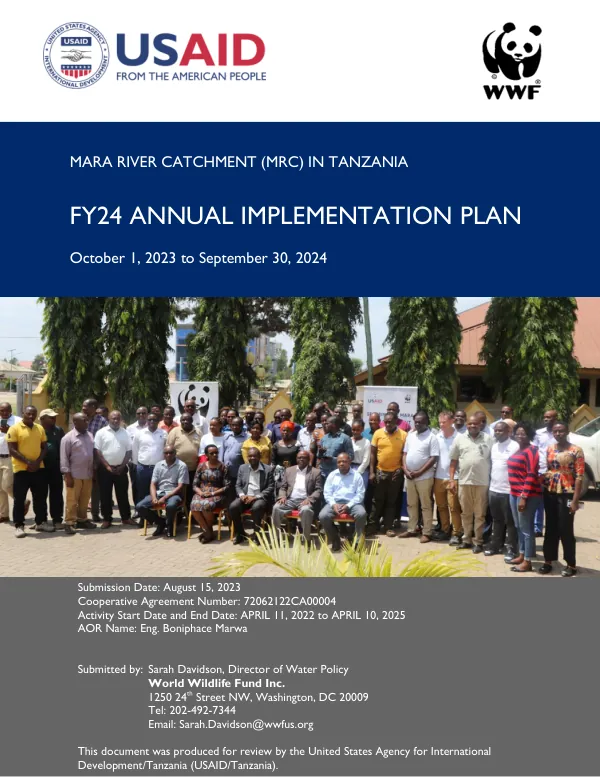
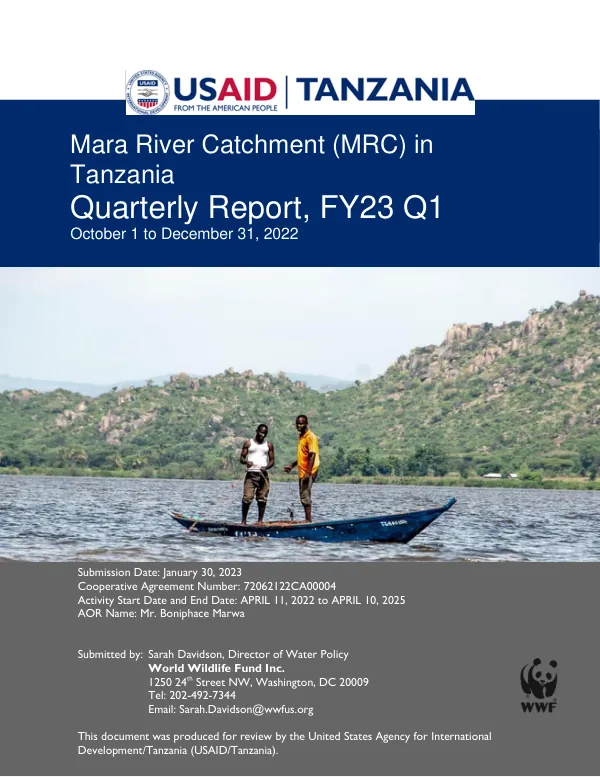
Mara River Catchment (MRC) in Tanzania Quarterly Report, FY23 Q1
The Mara River Catchment (MRC) in Tanzania project aims to contribute toward the vision of healthy communities and a sustainable, growing economy in the MRC that are supported by thriving freshwater ecosystems.
2023 · 18 pages
Sign in to readA free account is required to download.
Abstract
The project will strengthen transboundary water governance in the Mara River Catchment, build the capacity of key water governance institutions, increase access to real-time water quantity and flows data, rehabilitate water sources, and support best practices in water resources use. The project will achieve three intermediate results: Water Institutions in the MRC in Tanzania are enabled to engage, coordinate, and implement transboundary water resources governance. Community livelihoods and water supply are improved through water resources conservation in the MRC in Tanzania. Recommendations are made for water users on financing mechanisms that enhance catchment conservation for the MRC in Tanzania. The project will take place in the Mara River Catchment in the north-west of Tanzania in Musoma, Serengeti, Rorya, Butiama, Tarime, and Bunda districts. The project will benefit 20,000 people through water resource conservation, 6,000 people through improved water supply schemes, and 1,200 farmers with new skills to better conserve water and soil in productive land near water source areas. Implementation of the project began in October 2022, with the arrival of new project staff and the completion of community consultations. However, the pace of implementation has been the biggest challenge in the project so far, due to recruitment delays for WWF Tanzania. Despite these challenges, the project team has made progress, including conducting community consultations and advancing conversations with WWF Kenya, LVBWB, and the Office of the Mara Regional Administrative Secretary relating to transboundary water management. The project has not yet begun collecting data on the indicators included in the MEL Plan, as implementation is not advanced enough. The indicators include the number of water and sanitation sector institutions strengthened to manage water resources or improve water supply and sanitation services, and the number of river health assessments conducted. The project will work with communities across six districts, benefitting 20,000 people through water resource conservation, 6,000 people through improved water supply schemes, and 1,200 farmers with new skills to better conserve water and soil in productive land near water source areas. The project will achieve its objectives through the support of key water governance institutions, the rehabilitation of water sources, and the promotion of best practices in water resources use. The project has made progress in advancing conversations with key stakeholders, including WWF Kenya, LVBWB, and the Office of the Mara Regional Administrative Secretary. These conversations support the project objectives and will contribute to the achievement of the project's intermediate results. The project team is working to address the challenges faced in the first quarter, including recruitment delays, and is committed to achieving the project's objectives.