USAID DEC
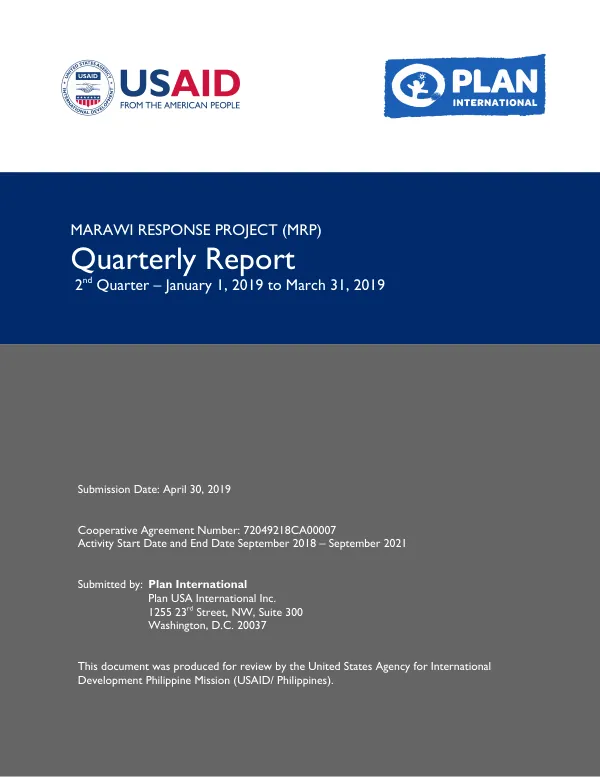
Marawi Response Project (MRP) Quarterly Report 2nd Quarter – January 1, 2019 to March 31, 2019
Sign inPLAN INTERNATIONAL USA
Marawi Response Project (MRP) Quarterly Report 2nd Quarter – January 1, 2019 to March 31, 2019
The Marawi Response Project (MRP) is a three-year initiative implemented by Plan International USA in partnership with local organizations Ecosystems Work for Essential Benefits (ECOWEB) and the Maranao People Development Center, Inc.
2019 · 22 pages
Sign in to readA free account is required to download.
Abstract
(MARADECA) to support USAID/Philippines. The project aims to increase the self-reliance of internally displaced persons (IDPs) and host community members affected by the Marawi siege. The overall goal of MRP is to improve economic conditions and strengthen community cohesion in communities hosting large numbers of IDPs. To achieve this purpose, the project focuses on two Intermediate Results (IR): IR 1, which involves providing capacity building of IDPs and host community members on business management, livelihood, and skills development, provision of grants for business and livelihood, and increasing access to local and regional markets; and IR 2, which focuses on the delivery of community grants and civic engagement training to strengthen community cohesion. MRP utilizes an integrated, community-based, private sector-driven, and market-oriented approach to improve the economic conditions of IDPs and host communities. During the 2nd quarter of 2019, MRP built on the groundwork laid in the first quarter, developing grant proposals, beginning training activities, and continuing to finalize its operational structure. Twenty-five new Community Solidarity Groups (CSGs) were formed during the quarter, mainly from Baloi, Iligan City, and Butig. As of March 31, 2019, a total of 184 CSGs had been formed in 41 barangays. MRP's partners conducted an additional twenty participatory conflict assessments with 54 CSGs from 14 barangays. A total of 91 proposals were submitted to the Grants Evaluation Committee (GEC) covering both business recovery and community grants. The proposals were based on priorities defined by the community solidarity groups (CSG) organized during the first quarter. Ten of these proposals were selected for submission to USAID for evaluation. MRP is awaiting USAID feedback on the proposals and, once granted, approval of all grants under $5,000 will shift to MRP's Chief of Party. The MRP team and its partners commenced livelihood and business training activities based on extensive training needs assessments (TNAs) made in consultation with the CSGs, including its youth and women members. Two trainings were conducted during the quarter, focused on dressmaking in Marantao, Lanao del Sur and Business Planning and Financial Management in Marawi City. MRP focused on improving coordination with government agencies and business organizations in the implementation of MRP activities. In particular, commitments of joint activities were planned with the Department of Trade and Industry (DTI) and the Task Force Bangon Marawi (TFBM). MRP also established networks with line agencies to ensure that proper procedures for the purchase of farming inputs are followed. In line with MRP's commitment to collaborative, learning, and adapting (CLA), MRP continued to refine the program implementation strategy through events such as the Pause and Reflect activities for the team and its partners, as well as orientations and trainings for its staff. The Pause and Reflect was held on February 13-14, 2019. USAID participated in the first day during which the site selection process, the work plan, the Activity Monitoring and Evaluation Plan (AMELP), and the Business Management Plan (BMP) were discussed. During the P&R session, USAID and MRP jointly decided to revise the project's goal statement and theory of change. The revised goal statement focuses on increasing self-reliance of IDP and host community members affected by the Marawi siege. The MRP MERL team revised the AMELP to align with the new goal statement and theory of change. The MERL team also worked closely with Souktel during this quarter to tailor and test the online M&E platform, which will be used to collect, analyze, and visualize data that can be used for decision making. Operationally, MRP continued to bring new staff on board, including an Economic Development Officer, Social Cohesion Officer, two Grants Assistants, two Procurement Assistants, and a Compliance Officer. The team moved to the new office in March, which has a large space that can be used for trainings.