MERCY CORPS INTERNATIONAL
Market Assessment Report: Water Saving Market in Jordan
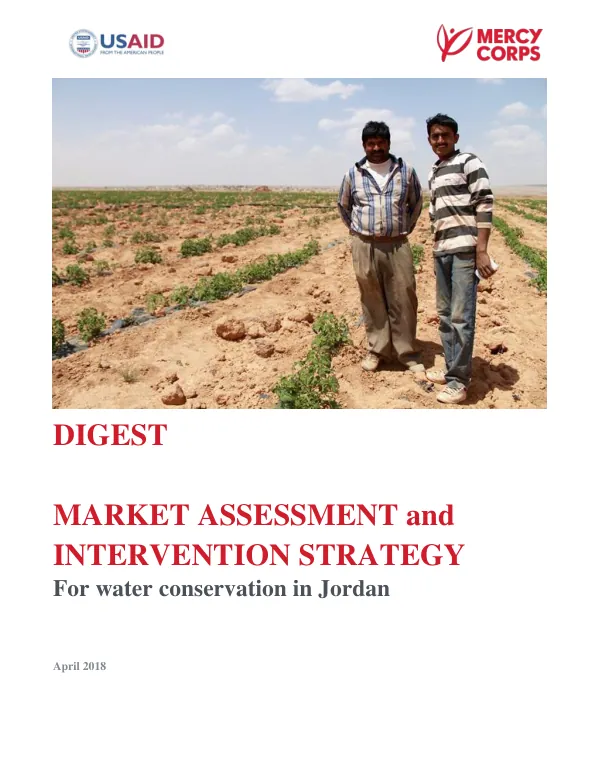
The agricultural and horticulture sectors in Jordan, particularly the stone fruit and olive sub-sectors, are major consumers of fragile groundwater resources.
2018 · 11 pages
Sign in to readA free account is required to download.
Abstract
These sectors account for more than half of the national groundwater supply, with the majority of agricultural production remaining water inefficient. The Ministry of Water and Irrigation has a National Water Strategy (2016-2025) that promotes water efficiency, including through application of tariffs and incentives. The Water Innovations Technologies (WIT) project, implemented by Mercy Corps with funding from USAID, aims to save 18.5 million cubic litres of groundwater and sustainably improve water conservation to positively contribute to long-term water security for the country. The project targets water efficiency in the agriculture sector and among communities and households in the north of the country, where water reserves are under extreme pressure. The project will work with a range of agricultural input and technology suppliers, research groups, business development, and training and financial service providers to test, evaluate, and scale out proven and sustainable solutions to strengthen critical market functions and encourage accelerated adoption of water conserving technologies and practices. The market assessment conducted by WIT identified a range of critical market functions that need to be strengthened to promote water conservation among medium-sized stone fruit and olive farmers. These functions include information and advice, research and development, and skills and quality assurance. The assessment found that the availability of trusted, useful, and timely information or advice on appropriate water conservation practices is limited, and that there is a need for more robust agronomic and economic analysis to support the development of effective conservation practices. The WIT project has established feasibility of working with input suppliers, irrigation technology suppliers, academic institutions, farm owners, and farm managers to address the information gap and strengthen critical market functions. The project will build on the offer input suppliers make of embedded advisory services to large farms and explore approaches for stimulating demand among farm owners and farm managers for commercial training. The project will also explore options for drawing together academic research capabilities with robust agronomic and economic analysis to develop innovative and effective conservation practices. The WIT project recognizes strong emergent financial incentives among agricultural and irrigation technology suppliers for providing support to ensure their products are correctly used and maintained. Farm owners and farm managers also have incentives to seek advice and support for irrigation deployment, and have demonstrated demand for that advice where they deem it trustworthy, independent, and of sufficient relevance and value to their business. The project will build on this and encourage farmers to seek advice and support from suppliers, encouraging a response from suppliers.