CATHOLIC RELIEF SERVICES ORGANIZATION
Market Information Framework
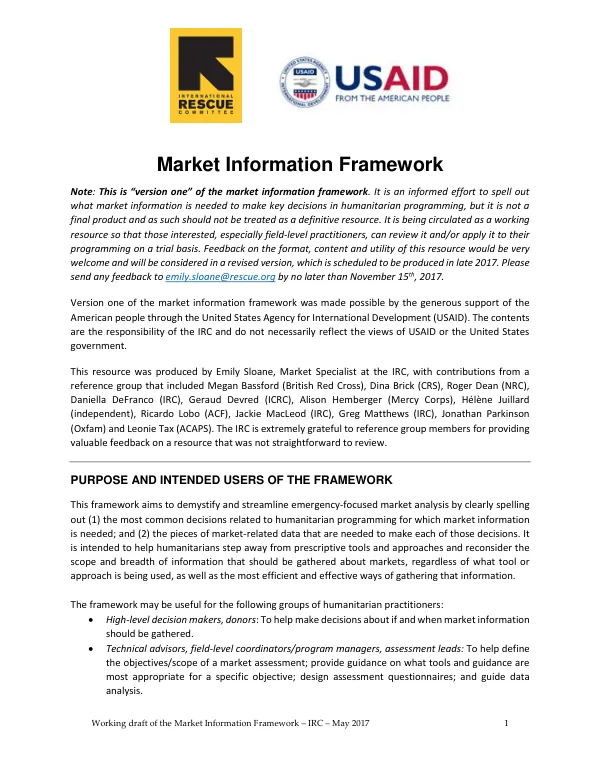
The Market Information Framework is a working draft aimed at demystifying and streamlining emergency-focused market analysis.
2017 · 10 pages
Sign in to readA free account is required to download.
Abstract
It clearly spells out the most common decisions related to humanitarian programming for which market information is needed and the pieces of market-related data required to make each decision. The framework is intended to help humanitarians reconsider the scope and breadth of information gathered about markets and the most efficient and effective ways of gathering that information. The framework consists of three parts: a guidance document and summary spreadsheet, detailed data lists, and an Excel version of the framework. The guidance document provides background information and instructions on how to use the framework, while the summary spreadsheet includes programmatic decisions, questions that inform each key decision, and a brief description of complementary information needed to make each decision. The detailed data lists provide all the data points needed to fully make each key decision, presented both as a full data list and organized by key questions that inform the key decision. The framework focuses on the most common decisions for which humanitarian actors should be considering market information, including decisions on the type of assistance to provide (cash-based or in-kind) and whether and what type of market support is needed throughout the program cycle. The framework is not intended to be comprehensive of all possible decisions and does not provide a detailed list of non-market-related information needed. It is focused on market-related information needed for specific programming decisions, including information about supply and demand. The framework is relevant to programs in any humanitarian sector that aim to help disaster-affected people access goods that are typically available for purchase in market places. It was not explicitly designed to encompass programs that help people access services, although some of the content is relevant to services. The framework is applicable to both pre-disaster and post-disaster contexts, as well as in different types of disasters. The framework was made possible by the generous support of the American people through the United States Agency for International Development (USAID). The contents are the responsibility of the International Rescue Committee (IRC) and do not necessarily reflect the views of USAID or the United States government. The framework was produced by Emily Sloane, Market Specialist at the IRC, with contributions from a reference group that included representatives from various humanitarian organizations. The framework is not a tool for humanitarian market analysis, but rather a guide to the information needed to make specific decisions. It does not advocate for specific tools or approaches, recognizing that multiple tools and approaches can be used effectively to gather the same information. The user is left to determine the most appropriate and effective way to gather the information needed in a given context. The framework is organized into three categories of decisions: assessment, program design, and program implementation. Each category includes key decisions for which market-related data is necessary, along with questions that help to inform each key decision and a brief description of complementary information needed to make each decision. The framework also includes detailed data lists that provide all the data points needed to fully make each key decision, presented both as a full data list and organized by key questions that inform the key decision. The framework is focused on market-related information needed for specific programming decisions, including information about supply and demand. It is not a comprehensive guide to all possible decisions, but rather a tool to help humanitarians make informed decisions about market information. The framework is relevant to programs in any humanitarian sector that aim to help disaster-affected people access goods that are typically available for purchase in market places.