USAID DEC
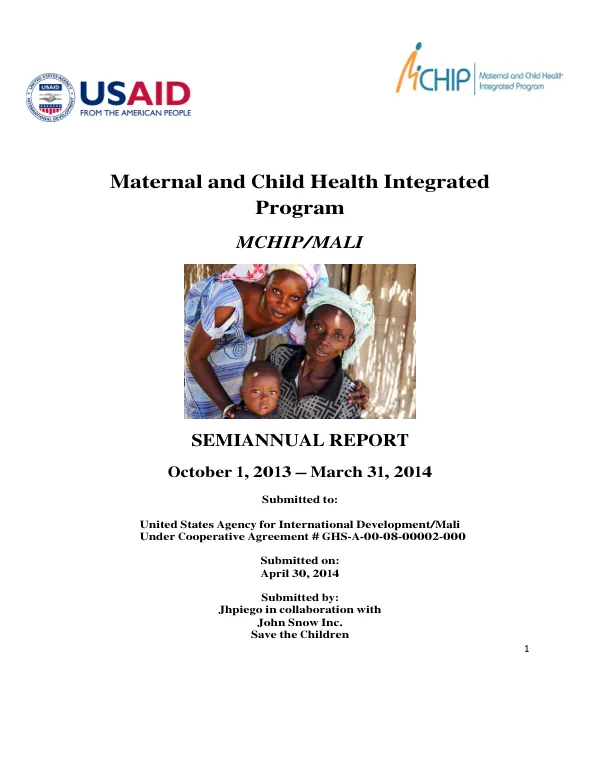
Maternal and Child Health Integrated Program MCHIP/MALI SEMIANNUAL REPORT October 1, 2013 – March 31, 2014
Sign inJHPIEGO
Maternal and Child Health Integrated Program MCHIP/MALI SEMIANNUAL REPORT October 1, 2013 – March 31, 2014
MCHIP's goal in Mali is to contribute to the reduction of maternal, newborn, and child mortality.
2014 · 53 pages
Sign in to readA free account is required to download.
Abstract
The program has worked strategically at the national, district, and community levels since 2010, building and expanding on existing platforms to promote proven and effective approaches. MCHIP works to ensure increased access to and utilization of integrated, evidence-based packages of maternal, newborn, child health, and family planning (MNCH/FP) interventions at both community and facility levels. MCHIP/Mali Fiscal Year 2014 (FY14) Objectives include contributing to improved national health strategies, policies, and programs that increase the population's access to an affordable integrated package of high-impact MNCH/FP interventions. The program also aims to improve access to and the quality and efficiency of the essential community package (SEC) through implementation and M&E support in the two regions of Kayes and Sikasso. Additionally, MCHIP seeks to improve access to and the quality and efficiency of facility-based integrated services in Community Health Centers (CSCOMs). Key achievements this semester include the expansion of the integrated maternal, newborn health, and family planning (MNH/FP) facility-based package to five Sikasso districts. A qualitative study on SEC was implemented to assess poor utilization issues identified by the 2012/2013 LQAS study. Thirty-six women community leaders from the seven project districts were trained in social mobilization and MNCH best household practices. MCHIP's collaboration and coordination with the Ministry of Health (MOH) at both the national and regional levels were re-established and intensified following the un-suspension of US government engagement with the Government of Mali. MCHIP supported the MOH on "A Promise Renewed" activities through conducting a Child Survival Desk Review. The study was followed by the dissemination of the report at the national level and a presentation at an APR partners meeting at WHO. Coordination between the National Malaria Prevention Program (PNLP), the Reproductive Health Division (DNS), and other stakeholders was initiated through the development of the malaria in pregnancy (MIP) technical working group (TWG). MCHIP continued collaboration with various civil society partners, including the Malian Association of Municipalities (AMM) and the National Federation of Community Health (FENASCOM), which are working with the MOH to establish a sustainable mechanism to support ASCs (community health workers) salaries. Implementation of a data quality assessment was also undertaken to review the quality of data management, collection, and reporting. MCHIP continued to play an active leadership and coordination role amongst SEC implementing partners as the Secretariat of the MOH SEC Ad Hoc Group and the SEC Focal Group. The program provided technical and financial support for the revision and validation of the training tools for relais and participated in the review and validation of the national reproductive health (RH) strategy. A Child Survival (CS) Desk Review was conducted to inform the national APR strategy development, and a mapping of mayors and other actors contributing to the support of ASC at community levels was implemented to support the establishment of a sustainable approach for ASC salaries.
Related documents