JHPIEGO
Maternal and Child Health Integrated Program (MCHIP) South Sudan FY13_Q1_Report
The Maternal and Child Health Integrated Program (MCHIP) in South Sudan is a partnership between the U.S.
2013 · 6 pages
Sign in to readA free account is required to download.
Abstract
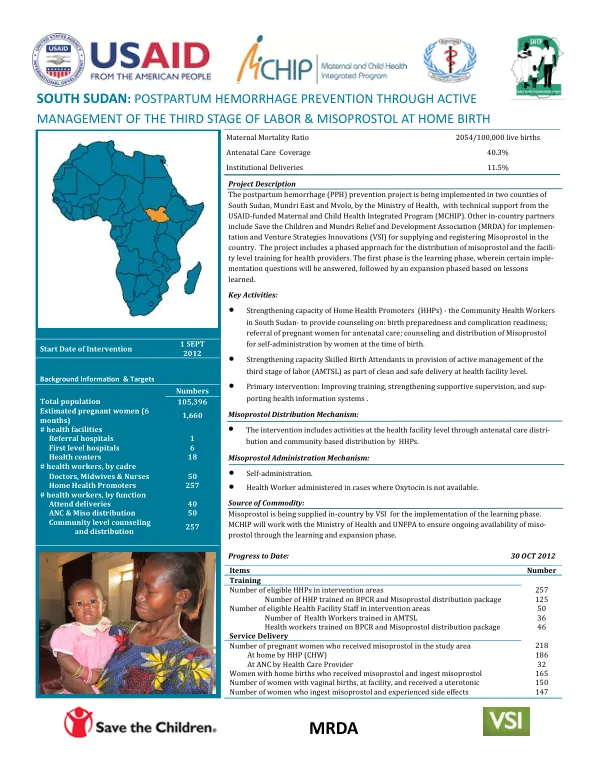
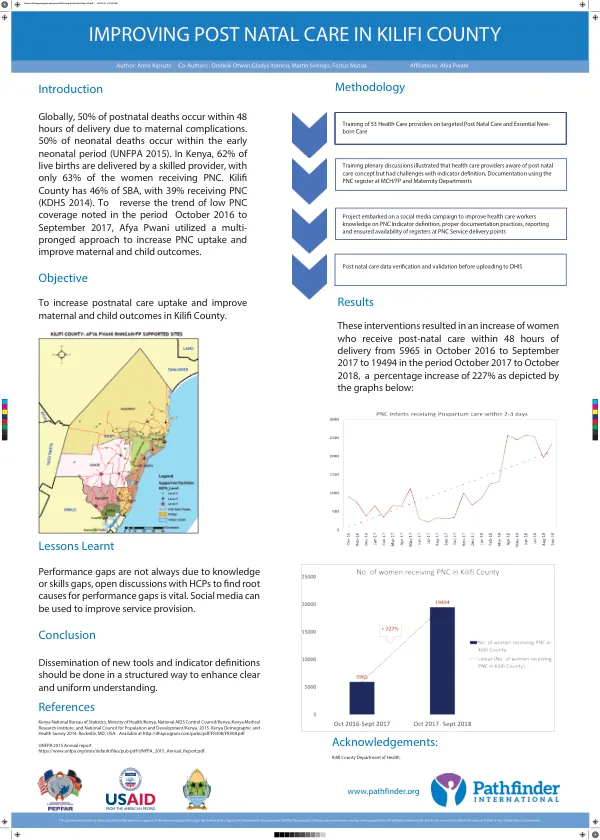
Agency for International Development (USAID) and two strategic partners, Jhpiego and John Snow Inc. (JSI). The program's goal is to assist in scaling up evidence-based, high-impact maternal, newborn, and child health (MNCH) interventions, contributing to significant reductions in maternal and child mortality and progress toward Millennium Development Goals 4 and 5. MCHIP commenced in South Sudan in Program Year (PY) 1 with support to the Expanded Program on Immunization (EPI), continuing work started under the MCHIP predecessor project, IMMUNIZATIONbasics. In 2009, MCHIP provided external technical support for the development of the national EPI policy and the adaptation of key EPI training packages, including the Reaching Every District and Immunization in Practice modules. The program also invested in two long-term technical advisors who were embedded within the Ministry of Health (MOH) to build institutional and managerial capacity. The program objectives are four-fold: to build capacity for family planning and reproductive health, to strengthen human resources in the areas of monitoring and evaluation for HIV/AIDS, to disseminate the national EPI policies and support a national, multi-partner EPI review, and to support a program for the prevention of postpartum hemorrhage (PPH). To achieve these objectives, MCHIP implemented various activities, including convening technical working groups, providing technical assistance to the MOH, and supporting the development of national policies and guidelines. In the area of family planning and reproductive health, MCHIP participated in the verification of the quality of printouts of the RH Strategy, RH Policy, and FP Policy. The program also convened three FP Technical Working Groups, hosted by Marie Stopes International, MCHIP, and UNFPA, to discuss topics such as the participation of stakeholders in FP/RH in the dissemination of policies and the review of the FP training curriculum for service providers. In the area of HIV/AIDS monitoring and evaluation, MCHIP assisted the MOH and SSAC in drafting the National Strategic Plan on HIV and AIDS (NSP) 2012-2016. The program also supported the MOH and SSAC in compiling annual HIV/AIDS services data for 2012 and worked with the MOH in responding to HIV/AIDS data requests from development partners. In the area of EPI, MCHIP completed activities under this objective in FY12. In the area of PPH, MCHIP provided short-term technical assistance to health providers in clean and safe birth, including active management of the third stage of labor and immediate newborn care, as well as management of PPH. The program also trained a total of 260 HHPs in Mvolo and Mundri East Counties and delivered a prevention of PPH program update at the RH Forum meeting. Data summary for the two counties indicates that a total of 2,441 new pregnant women were registered for ANC, with 280 facility deliveries and 220 women receiving oxytocin within 3 minutes of delivery. A total of 485 clients received misoprostol, with 344 women delivered at home and taking misoprostol.