USAID DEC
SOUTH SUDAN: POSTPARTUM HEMORRHAGE PREVENTION THROUGH ACTIVE MANAGEMENT OF THE THIRD STAGE OF LABOR & MISOPROSTOL AT HOME BIRTH
Sign inMINISTRY OF HEALTH
SOUTH SUDAN: POSTPARTUM HEMORRHAGE PREVENTION THROUGH ACTIVE MANAGEMENT OF THE THIRD STAGE OF LABOR & MISOPROSTOL AT HOME BIRTH
The postpartum hemorrhage (PPH) prevention project in South Sudan aims to reduce maternal mortality through active management of the third stage of labor and the use of Misoprostol at home births.
2012 · 1 pages
Sign in to readA free account is required to download.
Abstract
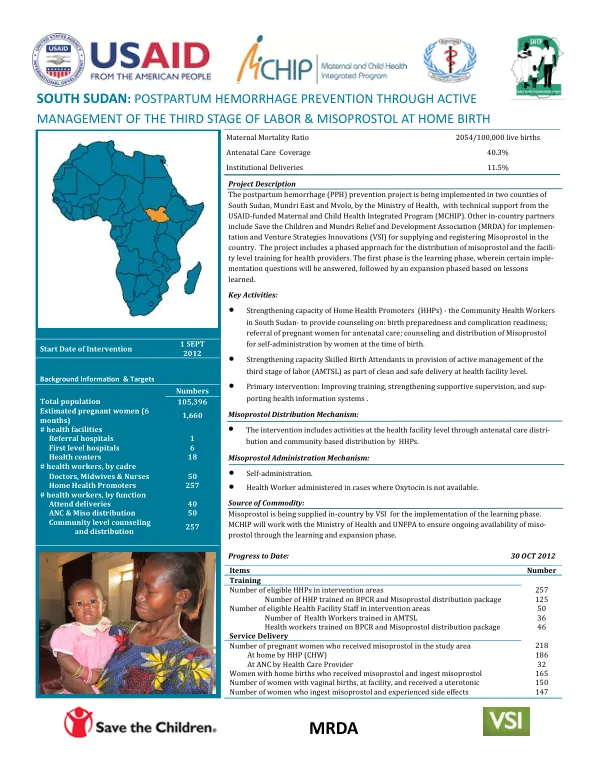
The project is being implemented in two counties, Mundri East and Mvolo, by the Ministry of Health with technical support from the USAID-funded Maternal and Child Health Integrated Program (MCHIP). Other in-country partners include Save the Children and Mundri Relief and Development Association (MRDA) for implementation and Venture Strategies Innovations (VSI) for supplying and registering Misoprostol in the country. The project includes a phased approach for the distribution of Misoprostol and the facility-level training for health providers. The first phase is the learning phase, where certain implementation questions will be answered, followed by an expansion phase based on lessons learned. Key activities include strengthening the capacity of Home Health Promoters (HHPs) to provide counseling on birth preparedness and complication readiness, referral of pregnant women for antenatal care, and counseling and distribution of Misoprostol for self-administration by women at the time of birth. Strengthening the capacity of Skilled Birth Attendants in the provision of active management of the third stage of labor (AMTSL) is also a key activity. The primary intervention involves improving training, strengthening supportive supervision, and supporting health information systems. Misoprostol distribution will occur through antenatal care distribution and community-based distribution by HHPs. Women will self-administer Misoprostol, or health workers will administer it in cases where Oxytocin is not available. The project has made significant progress since its start date of September 1, 2012. As of October 30, 2012, 125 HHPs were trained on the birth preparedness and complication readiness (BPCR) and Misoprostol distribution package, while 36 health workers were trained in AMTSL. A total of 218 pregnant women received Misoprostol in the study area, with 186 receiving it at home from HHPs and 32 receiving it at antenatal care from health care providers. The project aims to improve maternal health outcomes in South Sudan by reducing postpartum hemorrhage and increasing access to safe delivery services.