JHPIEGO
Maternal and Child Health Integrated Program Associate Award PY4 Semi-Annual Report
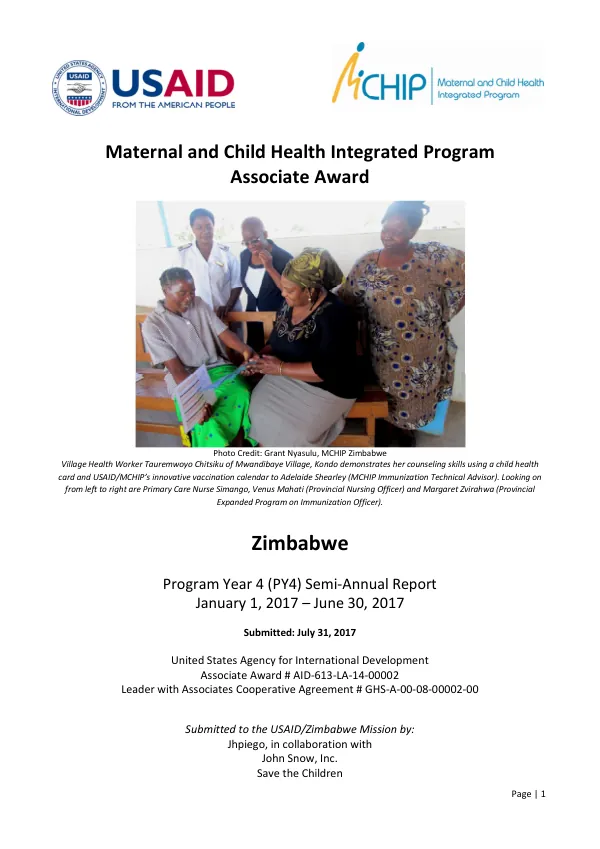
The Maternal and Child Health Integrated Program (MCHIP) in Zimbabwe continued to support the Zimbabwean Ministry of Health and Child Care (MOHCC) in strengthening the capacity of the MOHCC at national and provincial levels to improve Maternal Newborn and Child Health (MNCH) services.
2017 · 46 pages
Sign in to readA free account is required to download.
Abstract
The program's work plan activities were organized according to three objectives: to strengthen the capacity of the MOHCC at national level, to strengthen the capacity of the MOHCC at provincial and district level, and to strengthen the capacity of Civil Society Organizations (CSOs) to effectively implement MNCH activities. MCHIP provided technical assistance to the MOHCC and Family Health Department during their integrated review and planning meeting at the beginning of the year. The program supported the MOHCC to implement planned activities, including the development and printing of Zimbabwe's Reproductive Maternal Newborn Child and Adolescent Health and Nutrition (RMNCAH-N) Strategy. The strategy aimed to improve the quality of care, maternal health, newborn health, child health, immunization, community, nutrition, and malaria services. Key MOHCC priorities in 2017 included improving the quality of maternal health services, institutionalizing maternal and perinatal death surveillance and response, aligning antenatal care guidelines to current World Health Organization (WHO) recommendations, conducting on-the-job training, strengthening mentorship of district health care workers, and strengthening monitoring and evaluation systems. MCHIP also supported the launch of the Child Survival Strategy, scaling up Emergency Triaging Assessment and Treatment plus admission (ETAT+), expanding community Vitamin A supplementation, and strengthening child growth monitoring. The program continued to support the implementation of high-impact interventions at both national and provincial levels, with a focus on learning and research activities. The program's progress was highlighted in the semi-annual report, which included information on the quality of care, maternal health, newborn health, child health, immunization, community, nutrition, malaria, and health promotion. The report also described high-level changes to selected indicators, summarized management-, finance-, and administration-related progress, and discussed challenges encountered and opportunities seized in the current operating environment. The Nyanga Quality Improvement Support Team (QIST) played a key role in supporting the implementation of quality improvement initiatives, including the development of a quality improvement plan and the establishment of a quality improvement team. The team worked closely with the Family Health Director, Deputy Director of Reproductive Health, and other stakeholders to implement quality improvement initiatives. MCHIP also supported the implementation of the Expanded Program on Immunization (EPI) and the National Malaria Control Program (NMCP). The program provided technical assistance to the MOHCC and other stakeholders to strengthen the capacity of the EPI and NMCP to implement high-impact interventions. The program's progress was also highlighted in the attached Annexes, which included information on progress towards annual indicator targets, participation in world health days, meetings and conferences, findings from environmental compliance monitoring, on-site data verification assessments, and travel and short-term technical assistance.
Related documents