USAID DEC
Maternal and Child Survival Program Invigorates Nursing and Midwifery Education in Tanzania
Sign inTANGANYIKA GOVERNMENT
Maternal and Child Survival Program Invigorates Nursing and Midwifery Education in Tanzania
The Maternal and Child Survival Program (MCSP) has supported the revitalization of nursing and midwifery schools in Tanzania by providing IT equipment, medical supplies, and learning materials.
2015 · 2 pages
Sign in to readA free account is required to download.
Abstract
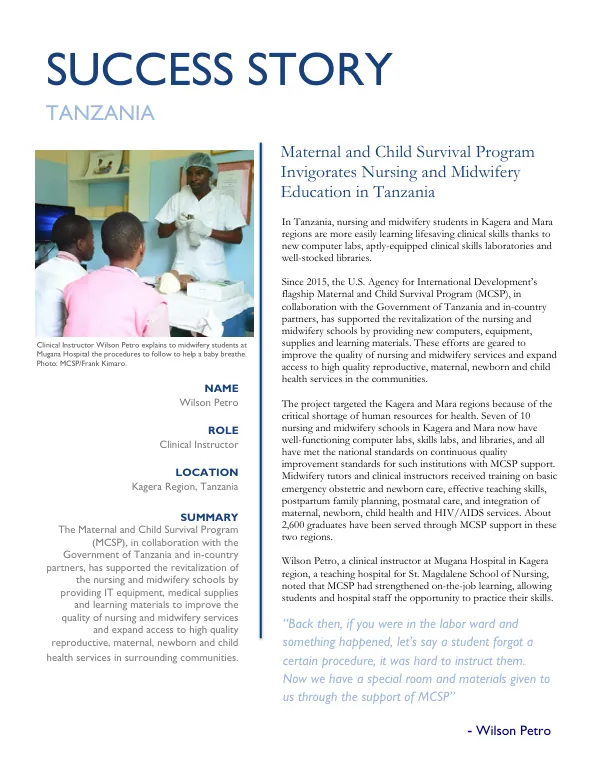
This effort aims to improve the quality of nursing and midwifery services and expand access to high-quality reproductive, maternal, newborn, and child health services in surrounding communities. In Kagera and Mara regions, MCSP has targeted areas with a critical shortage of human resources for health. The project has established well-equipped computer labs, skills labs, and libraries in seven out of ten nursing and midwifery schools. These institutions have met national standards for continuous quality improvement standards with MCSP support. Clinical Instructor Wilson Petro at Mugaha Hospital in Kagera region has reported significant improvements in on-the-job learning for students and hospital staff. MCSP introduced the concept of a preceptor corner, a special room for instruction or supervision during practice. This innovation has enabled students to practice their skills more effectively, as seen in a case where a student was able to confirm the necessary equipment for an episiotomy procedure. MCSP has also provided vital signs equipment, tape measures, pinard, kits for labor and delivery, and newborn resuscitation, as well as training videos to prepare and instruct nursing and midwifery students. The program operates in seven regions in Tanzania, collaborating with partners to strengthen human resources for health and improve the quality and sustainability of integrated health services. The Maternal and Child Survival Program has served over 2,600 graduates in Kagera and Mara regions. MCSP's efforts aim to prevent deaths among women and children by providing a robust package of health services delivered by confident, skilled nurses and midwives.