JOHN SNOW INTERNATIONAL
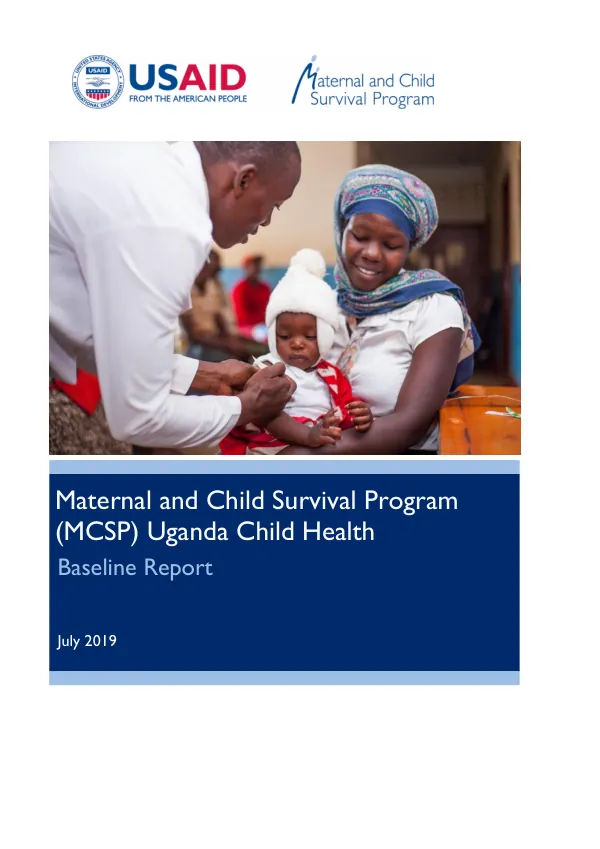
Maternal and Child Survival Program (MCSP) Uganda Child Health Baseline Report
The Maternal and Child Survival Program (MCSP) Uganda Child Health initiative aims to reduce child mortality in Uganda by implementing an integrated package of child health interventions, the essential child health package (ECHP).
2019 · 60 pages
Sign in to readA free account is required to download.
Abstract
The program will be implemented in four demonstration districts in the South West and East Central regions. The baseline assessment was conducted to collect information and guide planning of MCSP CH work plan activities, as well as facilitate measurement of impact in concert with an endline assessment at health facility (HF) level. The key objectives of the baseline assessment were to collect information for benchmarking MCSP CH interventions on human resources for ECHP, availability of basic infrastructure and equipment at HFs, availability of essential medicines and commodities, availability of key resources and support at the district level, and completeness, accuracy, and reporting of CH data from HFs. Additionally, the assessment aimed to determine baseline service utilization levels and case management practices for three priority childhood illnesses of malaria, diarrhea, and pneumonia at all levels of HFs in the four demonstration districts. A cross-sectional assessment of all functional HFs covering 147 HFs, and district health offices in the four districts was conducted between August and September 2017. Data collection methods included review of records and documents at the HFs and key informant interviews at the districts and HF level. The assessment revealed several key findings, including a scarcity of training of trainer (ToTs) teams and mentors for Integrated Management of Neonatal and Childhood Illness (IMNCI) across the four districts. Only nine health workers had ever been trained as trainers across the four districts, and none of these had received refresher training in the last three years. Staffing levels in the four demonstration districts were below 60%, and employed staff had little or no training in IMNCI. Only 96 out of 1,164 staff had undergone a Ministry of Health (MOH)-accredited IMNCI training in the past two years. The assessment also found that over 80% of the health facilities across the four demonstration districts had outpatient department (OPD) clinic areas for patient registration and triage for case management. Three quarters of the OPD areas were reported to offer visual and audio privacy. The most reliable source of clean water in the HFs was rainwater (41%), followed by piped water (37%), and borehole (24%) water. A striking 30% of the HFs did not have any water supply, reaching as high as 41% of HFs in Luuka that reported no water supply. About 79% of HFs had a documented procedure for waste management that involved either use of rubbish pits and/or burning. The majority of the HFs relied on solar energy for power supply (46%), followed by main grid power (34%). Nearly a third of the HFs reported not having any regular power supply. Access to functioning emergency vehicles is universal for hospitals and health center IV (HC IV) facilities, while only 44% and 30% of health center III (HC III) and health center II (HC II) facilities, respectively, reported to have access to emergency vehicles at cost or free during patient referrals. About 40% to 50% of HFs reported having access to functional vehicles, except in Luuka district where only 16% of HFs reported such access. Only 26% of the HFs reported having a dedicated, functional line of communication to support patient referrals. Access to a hand-washing stall equipped with running water and soap was generally higher around the consultation room (64%) compared to treatment rooms (51%). Almost all HFs (94%) had at least one functional pit latrine or toilet for clients and staff in the facility compound. However, access to soap and water in hand-washing facilities near the latrine or toilet was observed at only 49% of HFs. Prolonged stock-outs of key CH-related Health Management Information Systems (HMIS) tools were experienced by all the districts. All districts experienced stock-outs of more than 20 days for key CH-related HMIS tools, including the child register, village health team (VHT) register, HMIS Form 105, referral notes, and VHT reporting forms. In Luuka, Kaliro, and Sheema districts, the stock-out duration for these tools went up to 90 days. The quality of data reported in HMIS was found to be inadequate. Most of the data quality assessments revealed that the data was not complete, accurate, or up-to-date. The assessment also found that the districts experienced stock-outs of essential medicines and commodities, including oral rehydration salts (ORS), oral rehydration therapy (ORT), and artemisinin-based combination therapy (ACT). The districts also reported a shortage of staff, with staffing levels below 60% and employed staff having little or no training in IMNCI.