USAID
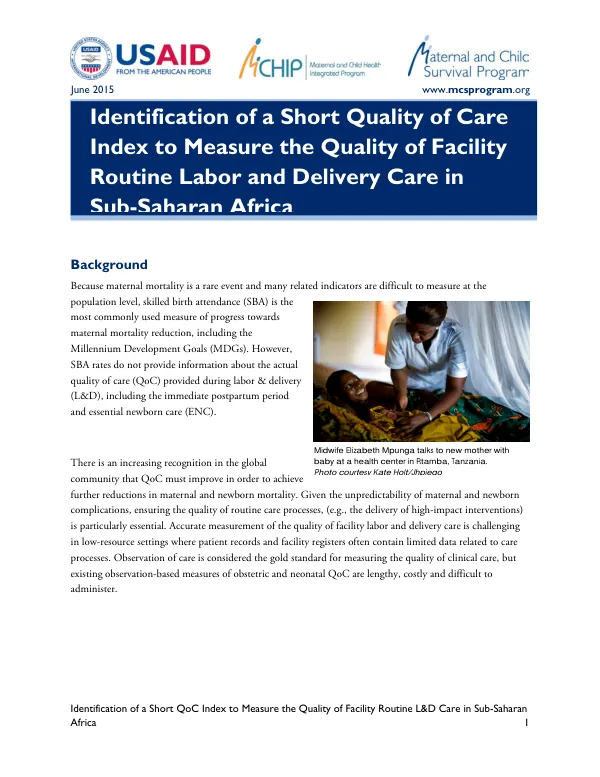
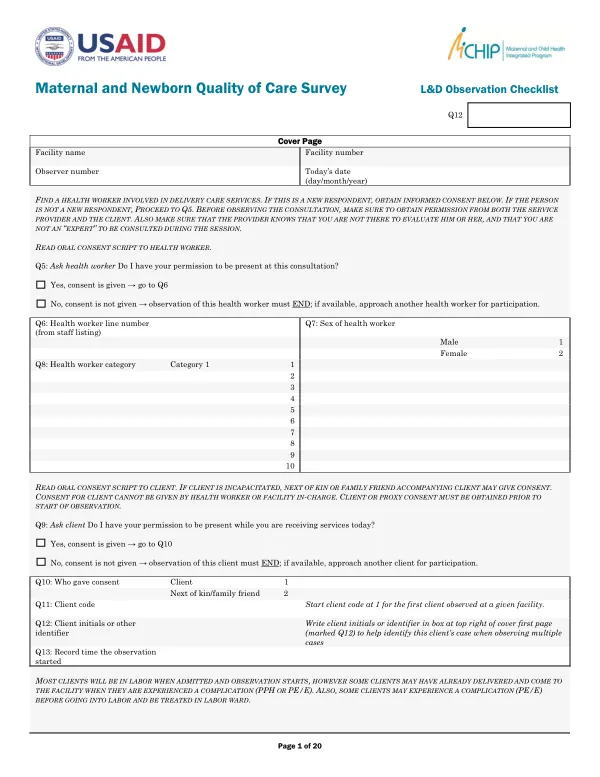
Maternal and Newborn Quality of Care Survey: L&D Observation Checklist
The Maternal and Newborn Quality of Care Survey is a comprehensive checklist designed to assess the quality of care provided to pregnant women and newborns during labor and delivery.
2013 · 20 pages
Sign in to readA free account is required to download.
Abstract
The survey is divided into several sections, each focusing on a specific aspect of care. Section 1: Initial Client Assessment is the first section of the survey, which evaluates the initial assessment of the pregnant woman. This section includes questions related to the provider's interaction with the woman, such as respectfully greeting her, encouraging her to have a support person present, and asking about her questions and concerns. The section also includes questions related to the provider's examination of the woman, such as taking her temperature, pulse, and blood pressure, and performing a general examination. The survey also assesses the provider's knowledge and counseling of the woman regarding her HIV status, including offering her an HIV test if her status is unknown. Additionally, the section evaluates the provider's assessment of the woman's previous pregnancies, including any complications she may have experienced. Section 2: Intermittent Observation of First Stage of Labor is the second section of the survey, which evaluates the provider's care during the first stage of labor. This section includes questions related to the provider's monitoring of the woman's progress, such as explaining what will happen in labor, encouraging her to consume fluids and food, and assisting her to ambulate and assume different positions. The section also includes questions related to the use of a partograph to monitor labor, as well as the provider's actions when an action line is reached on the partograph. The survey also assesses the provider's examination and procedures during labor, including performing a vaginal examination and informing the woman of her findings. Additionally, the section evaluates the provider's decision to refer the woman for a cesarean section, including the cause of the referral. The Maternal and Newborn Quality of Care Survey is a valuable tool for assessing the quality of care provided to pregnant women and newborns during labor and delivery. By evaluating the provider's knowledge, skills, and attitudes, the survey can help identify areas for improvement and promote better care for mothers and babies. The survey is designed to be used in a variety of settings, including hospitals, clinics, and community health centers. It can be used to evaluate the quality of care provided by individual providers, as well as to assess the overall quality of care provided by a facility or organization. The survey is based on the World Health Organization's (WHO) guidelines for the management of labor and delivery, as well as other international standards for maternal and newborn care. It is designed to be easy to use and understand, even for providers who may not be fluent in the local language. The survey is typically administered by a trained observer who is familiar with the local language and culture. The observer is responsible for recording the provider's responses to the survey questions, as well as any additional information that may be relevant to the assessment. The results of the survey can be used to identify areas for improvement in the quality of care provided to pregnant women and newborns. This information can be used to develop targeted interventions and training programs to improve the skills and knowledge of providers, as well as to promote better care for mothers and babies.