MCSP
MCSP Liberia Human Resouőces foő Health Pőoject
The MCSP Human Resources for Health Project in Liberia aimed to strengthen the capacity and resilience of the country's health workforce and basic and essential health services.
2018 · 1 pages
Sign in to readA free account is required to download.
Abstract
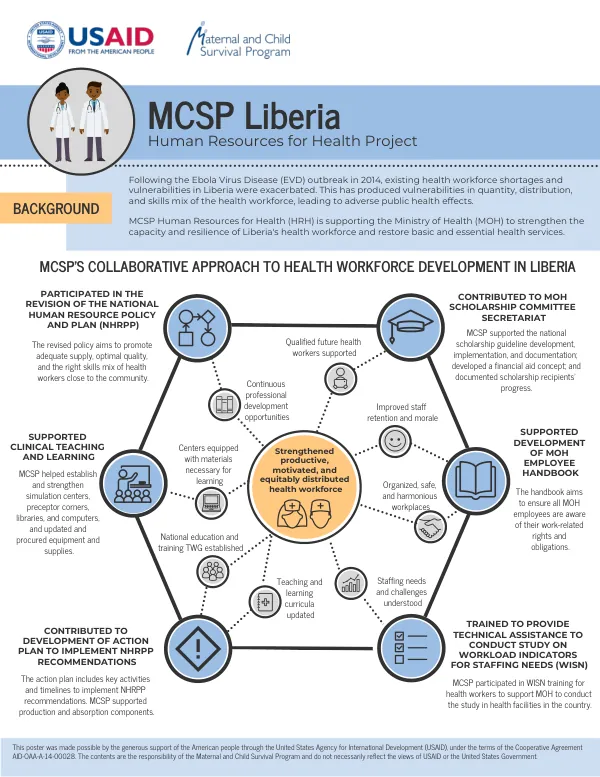
Following the Ebola Virus Disease outbreak in 2014, existing health workforce shortages and vulnerabilities in Liberia became exacerbated. This resulted in shortages in quantity, distribution, and skills mix of the health workforce, leading to adverse public health effects. The MCSP Human Resources for Health project supported the Ministry of Health (MOH) to revise the National Human Resource Policy and Plan (NHRPP). The revised policy aims to promote adequate supply, optimal quality, and the right skills mix of health workers close to the community. Key objectives include promoting adequate supply, optimal quality, and the right skills mix of health workers close to the community. The project contributed to the MOH Scholarship Committee Secretariat by supporting the development of a national scholarship guideline, implementation, and documentation. A financial aid concept was also developed, and scholarship recipients' progress was documented. Additionally, the project supported the development of an MOH Employee Handbook to ensure all employees are aware of their work-related rights and obligations. The project also supported the development of an action plan to implement NHRPP recommendations. The action plan includes key activities and timelines to implement NHRPP recommendations, with a focus on production and absorption components. Furthermore, the project contributed to the development of an action plan to implement NHRPP recommendations, including updating teaching and learning curricula, establishing a national education and training TWG, and establishing simulation centers, preceptor corners, libraries, and computers. The project's collaborative approach to health workforce development in Liberia aimed to strengthen the health workforce and improve health services. Key outcomes include improved staffing needs and challenges understanding, improved staff retention and morale, and qualified future health workers supported. The project also helped establish and strengthen simulation centers, preceptor corners, libraries, and computers, and updated and procured equipment and supplies.