MINISTRY OF HEALTH AND POPULATION
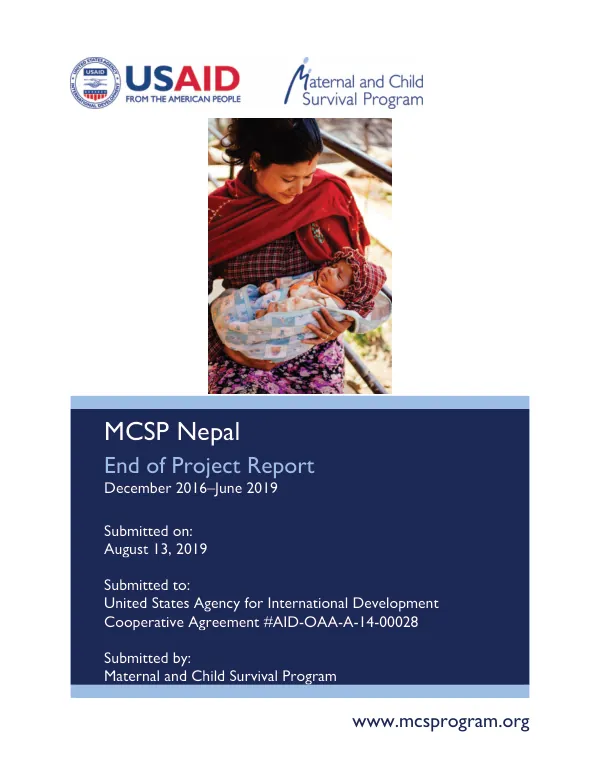
MCSP Nepal End of Project Report
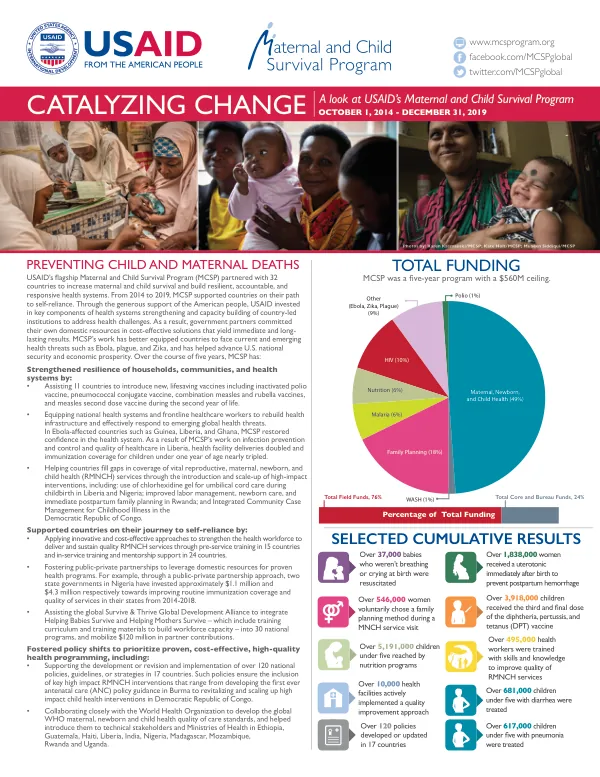
The Maternal and Child Survival Program (MCSP) is a global initiative funded by the United States Agency for International Development (USAID) to introduce and support scale-up of high-impact health interventions among USAID's 25 maternal and child health priority countries, as well as other countries.
2019 · 38 pages
Sign in to readA free account is required to download.
Abstract
MCSP is focused on ensuring that all women, newborns, and children most in need have equitable access to quality health care services to save lives. The program supports programming in maternal, newborn, and child health, immunization, family planning and reproductive health, nutrition, health systems strengthening, water/sanitation/hygiene, malaria, prevention of mother-to-child transmission of HIV, and pediatric HIV care and treatment. In Nepal, MCSP implemented two core-funded newborn health activities and one field-funded activity on possible severe bacterial infection (PSBI). The field-funded activity aimed to improve the management of PSBI in sick young infants, while the core-funded activities focused on strengthening inpatient care and integrated maternal, newborn, and child health (MNH) training. The program worked closely with Nepal's Ministry of Health and Population (MOHP), Family Welfare Division (FWD), and other stakeholders to achieve its objectives. The national survey on PSBI was conducted in 2017, which found that 22.6% of sick young infants had PSBI, with the highest prevalence in the Far-Western and Mid-Western regions. The survey also identified that 71.4% of facilities had a feedback system in place, and 64.7% of facilities reported having a support system for quality of care monitoring. However, only 35.3% of facilities had a discharge planning system in place. The PSBI pilot in Kavre District aimed to improve the management of PSBI in sick young infants. The pilot implemented a quality improvement package, which included training for healthcare providers, improvement of diagnostic tools, and establishment of a feedback system. The pilot achieved significant improvements in the management of PSBI, with a 25% reduction in mortality rates among sick young infants. The situation analysis of inpatient care found that 45.5% of facilities had a quality of care monitoring system in place, and 55.6% of facilities reported having a support system for quality of care monitoring. However, only 27.8% of facilities had a discharge planning system in place. The analysis also identified that 71.4% of facilities had a feedback system in place, and 64.7% of facilities reported having a support system for quality of care monitoring. The integrated MNH training study aimed to improve the skills of healthcare providers in providing MNH services. The study found that 85.7% of healthcare providers reported an improvement in their skills after the training, and 71.4% of facilities reported an increase in the number of MNH services provided after the training. The program achieved significant improvements in the management of PSBI, inpatient care, and MNH services. The program also strengthened the capacity of healthcare providers and facilities to provide quality health care services. The program's success can be attributed to its strong partnerships with stakeholders, including Nepal's MOHP, FWD, and other organizations. The program's achievements have contributed to the improvement of maternal, newborn, and child health outcomes in Nepal.