USAID DEC
MEAS Case Study # 6 on Small Farm Resource Centers in Asia
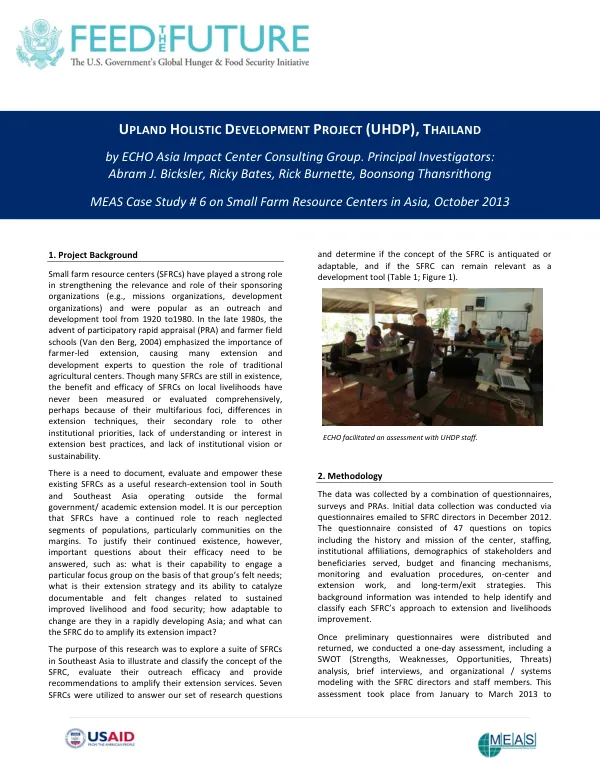
The Upland Holistic Development Project (UHDP) in Thailand was established in 1996 by American missionaries Rick and Ellen Burnette to improve the livelihoods and nutritional status of hilltribe groups in northern Thailand.
2013 · 17 pages
Sign in to readA free account is required to download.
Abstract
The project's initial focus was on the Dara Ang (Palaung) people, who were recent immigrants from Burma, and later on the Lahu and Kachin, many of whom were living in difficult situations as swidden-fallow agriculturists on the margins of national parks and national forests. The center was established in 1997 with the rental of 15 acres of land and subsequent purchase of that sloping upland area in 1998. The UHDP's mission statement emphasizes a participatory approach and community-based involvement to provide relevant and sustainable options for hilltribe communities. The center's main purpose is to demonstrate various appropriate techniques and methodologies of integrated upland farming and provide a place for research and study of new techniques for farmers in northern Thailand and upland farmers in the Golden Triangle region of Southeast Asia. The UHDP works with a staggering number of stakeholders, including beneficiaries of both center-based and outreach activities, and has two primary departments: the Small Farm Agroforestry Center (SFAC) and the Program Department. The SFAC is primarily tasked with upkeep, demonstrations, animal husbandry, research and development, and creation of outreach and administrative materials, while the Program Department is tasked with village extension work, information dissemination, needs assessment, and project monitoring and evaluation. Some of the focus groups of the center include representatives of other organizations, students, farmers, schools, churches, ethnic peoples' networks, colleges and universities, and government entities. ECHO Asia is also a local stakeholder, using the center as a seed production location and extending the outreach of UHDP beyond northern Thailand by integrating many of the proven UHDP techniques and methods into its global network of information dissemination. The UHDP has a diverse range of programs, including appropriate technology, pig husbandry, and help for villages in acquiring legal/citizenship status. Currently, staffing and resources are split between the Program Department, which mainly works with target villages (21), and the Small Farm Agroforestry Center (SFAC) Department, which runs and organizes the operations of the center. The UHDP has 15 full-time employees and is part of the Christian Service Foundation under the Church of Christ Thailand, with a board of trustees consisting of five members and one director. The organization's operating budget is approximately 500,000 THB ($17,030), sourced internally from training fees, lodging, rental fees for the ECHO seedbank, the sale of products sourced from the center, and individual donations. The UHDP's infrastructure includes 15 acres of land, 20 buildings, and a range of facilities such as meeting halls, libraries, offices, staff houses, volunteer houses, guest housing, nurseries, pig pens, animal rearing areas, a fish pond, a seedbank, plant grow-out areas, agroforestry areas, and common areas. The center's start-up costs associated with purchasing land and developing facilities over the first five years were approximately $150,000. The UHDP's mission and programs are focused on empowering hilltribe communities to rise above serious threats to their traditional rural livelihoods, and the center continues to expand and develop its services to meet the needs of its stakeholders.