KIMETRICA LLC
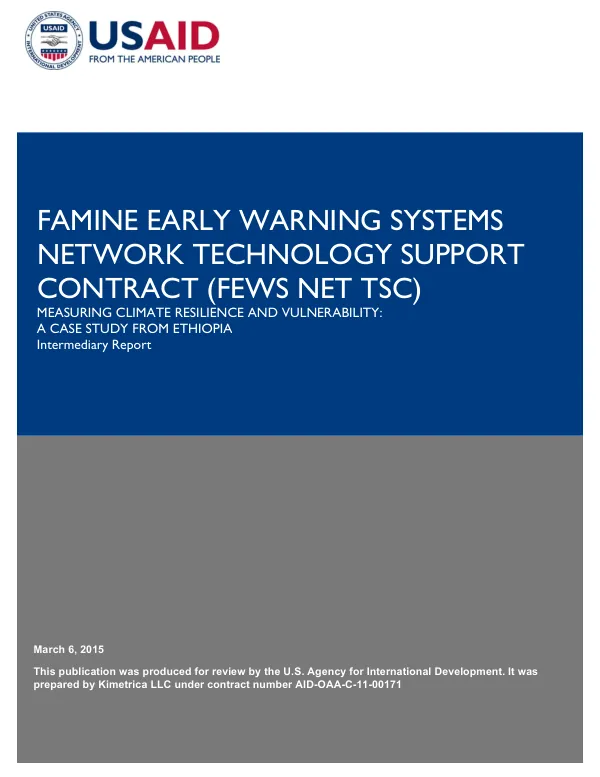
Measuring Climate Resilience and Vulnerability: A Case Study from Ethiopia
Measuring Climate Resilience and Vulnerability: A Case Study from Ethiopia is a report that presents a new methodology for assessing climate resilience and vulnerability.
2015 · 52 pages
Sign in to readA free account is required to download.
Abstract
The study aims to provide a framework for understanding the impact of climate variability on households and communities in Ethiopia. The methodology is based on a climate-consumption model that integrates climate data with household consumption data to estimate vulnerability and resilience indices. The climate-consumption model is a key component of the methodology, as it allows for the estimation of climate sensitivity and exposure. The model uses the Standardized Precipitation Index (SPEI) to quantify climate variability, and combines it with household consumption data to estimate the impact of climate on household well-being. The model has been tested on a case study from Ethiopia, where it was used to estimate vulnerability and resilience indices for different agro-ecological zones. The study found that climate sensitivity varies across agro-ecological zones, with households in the highlands subhumid and semiarid zones being more sensitive to climate variability. The study also found that households in the lowlands are more vulnerable to drought, while households in the highlands are more vulnerable to excessive moisture. The study's results suggest that the climate-consumption model is a useful tool for understanding the impact of climate variability on household well-being. The study's methodology has several desirable properties, including the ability to estimate climate sensitivity and exposure, and to quantify the impact of climate on household well-being. The study's results also highlight the importance of considering climate variability when designing development programs and policies. The study's findings have implications for policymakers and practitioners working in the field of climate change and development. The study's methodology has been tested on a case study from Ethiopia, where it was used to estimate vulnerability and resilience indices for different agro-ecological zones. The study's results suggest that the climate-consumption model is a useful tool for understanding the impact of climate variability on household well-being. The study's findings have implications for policymakers and practitioners working in the field of climate change and development. The study's conclusion emphasizes the need for further research on the impact of climate variability on household well-being, and the development of more robust and reliable methodologies for measuring climate resilience and vulnerability. The study's results also highlight the importance of considering climate variability when designing development programs and policies. The study's methodology has several desirable properties, including the ability to estimate climate sensitivity and exposure, and to quantify the impact of climate on household well-being.
Related documents