USAID
MELS Annual Survey Sampling Plan 2018
The Malawi MELS Annual Survey 2018 employed a stratified two-stage probability sample design to select participants supported by AgDiv during the 2017-2018 growing season.
2018 · 6 pages
Sign in to readA free account is required to download.
Abstract
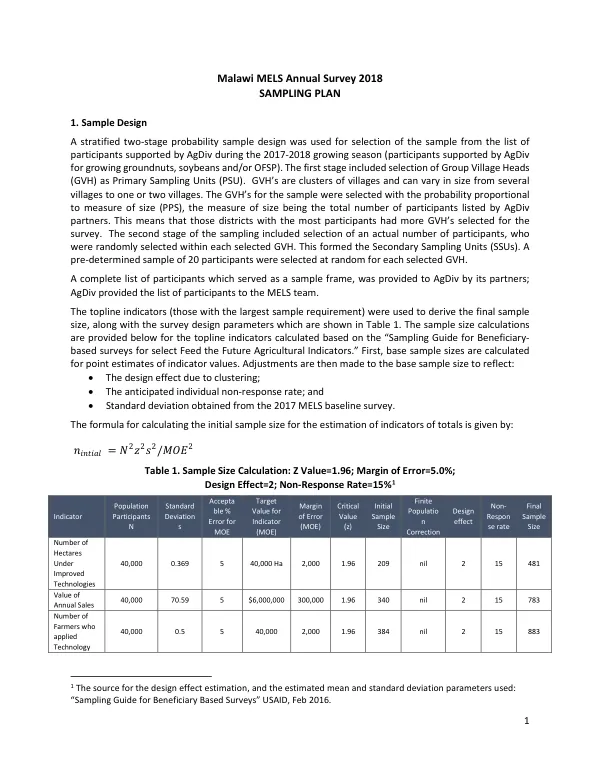
The first stage involved the selection of Group Village Heads (GVHs) as Primary Sampling Units (PSUs), with GVHs selected with probability proportional to measure of size (PPS). The measure of size was the total number of participants listed by AgDiv partners. This resulted in a higher number of GVHs selected from districts with more participants. The second stage of the sampling included the selection of an actual number of participants, who were randomly selected within each selected GVH. A pre-determined sample of 20 participants were selected at random for each selected GVH. The participant dataset provided to MELS by AgDiv contained incomplete data, such as the names of districts, EPAs, GVHs, and villages. To compensate for this, MELS oversampled, resulting in a total of 1,200 farmers in the sample. The topline indicators, including the number of farmers who applied improved technologies, were used to derive the final sample size. The base sample size for the indicator "Number of farmers who applied improved technologies" was 384 participants, which was corrected for design effect and non-response to yield a final sample size of 883 participants. However, due to the incomplete data, the final sample size was increased to 1,200 participants. The sampling weights were calculated with the design weight corrected for non-response for each of the selected clusters. Response rates were calculated at the cluster level as ratios of the number of interviewed units over the number of eligible units. The three components of the weighting included the first stage weights, which accounted for the varying probability of GVH selection; the second stage weights, which were simple weights obtained by dividing the total number of listed participants in the GVH by the number of selected participants in that GVH; and the non-response adjustment, which was equal to the selected participants (respondents + non-respondents) divided by the actual interviewed participants (responded farmers). The final weights for the i-th GVH in h-th stratum were calculated using the formula: W1hi = ∑ (Mhi / Nh) i=1 nh Mhi, where W1hi is the first stage weight, nh is the number of GVHs selected in h-th stratum, Mhi is the size of the i-th GVH in h-th stratum, and Nh is the stratum total of beneficiaries. The second stage weight was calculated as W2hi = Mhi / Lmh, where Lmh is the total number of beneficiaries in h-th stratum, and mhi is the number of selected beneficiaries for the i-th GVH in h-th stratum. The non-response adjustment was calculated as Rhi = 1 + m(nnr)hr / m(rr)hr, where m(nnr)hr is the number of beneficiaries who did not respond in i-th GVH of h-th stratum, and m(rr)hr is the number of beneficiaries who responded in i-th GVH of h-th stratum. The calculated weights are provided in Table 3, which shows the sampling weights applied for each GVH in each district. The overall weight for each GVH was calculated by multiplying the first stage weight, second stage weight, and non-response adjustment. The final weights were used to adjust the sample data to reflect the population characteristics.
Related documents