MACEDONIAN MINISTRY OF AGRICULTURE, FORESTRY AND WATER ECONOMY
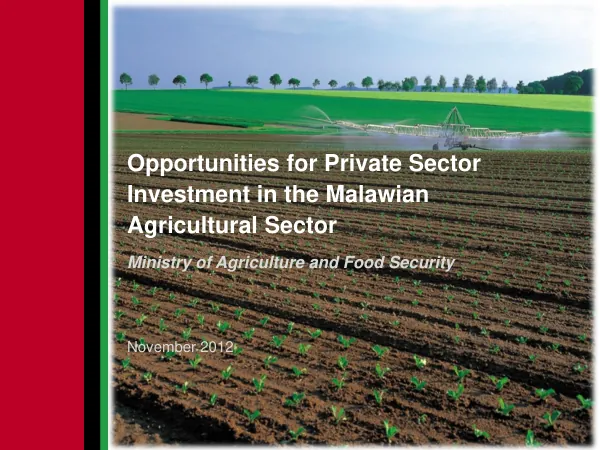
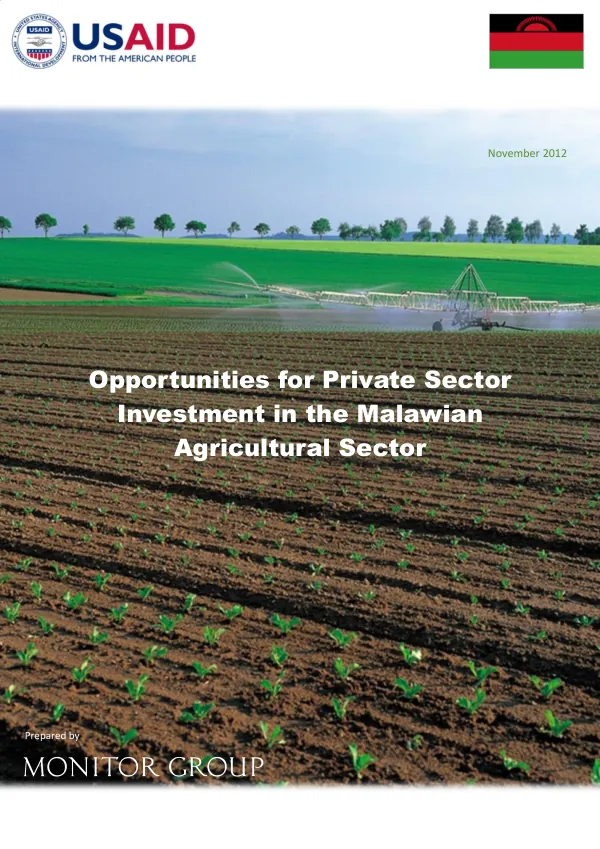
Opportunities for Private Sector Investment in the Malawian Agricultural Sector
The Malawian agricultural sector has significant potential for private sector investment.
2012 · 81 pages
Sign in to readA free account is required to download.
Abstract
Malawi's economy is primarily driven by agriculture, with the sector contributing approximately 34% to the country's GDP in 2011. The country's agricultural sector is characterized by a diverse range of crops, including maize, tobacco, and cotton, with maize being the primary staple crop. Malawi's agro-ecological zones are divided into four main categories: the highlands, mid-altitude, low-altitude, and lake-shore zones. The highlands are suitable for crops such as tea, coffee, and pyrethrum, while the mid-altitude zone is ideal for crops like maize, tobacco, and cotton. The low-altitude zone is primarily used for rice and sugarcane production, while the lake-shore zone is suitable for crops like fish and vegetables. The Malawian government has implemented various initiatives to accelerate investments in the agricultural sector. The government has developed sector strategies to harmonize interventions and policy reforms to foster an improved business enabling environment. Investment incentives have been put in place to drive private sector participation, and support has been provided for turnkey projects to develop necessary infrastructure. Despite the potential for private sector investment, there are several key risks that need to be mitigated. Political and regulatory risks are significant, with the government's ability to implement policies and regulations affecting the sector. Financial risks are also a concern, with limited access to credit and high interest rates affecting farmers' ability to invest in their businesses. Supply chain risks are another challenge, with issues related to transportation, storage, and marketing affecting the efficiency of the supply chain. Market risks are also a concern, with fluctuations in global commodity prices and changes in consumer demand affecting the sector. Investment opportunities in the Malawian agricultural sector are diverse and range from short-term to medium- to long-term investments. Short-term investment opportunities include the production and export of high-value crops such as tobacco and cotton. Medium- to long-term investment opportunities include the development of large-scale commercial farms and the establishment of agro-processing facilities. The government has also identified several key investment opportunities, including the development of the Strategic Grain Reserve and the expansion of the irrigation system. The Malawian government has also implemented several initiatives to support smallholder farmers, including the Farm Input Subsidy Programme and the Presidential Initiative for Poverty and Hunger Reduction. These initiatives aim to improve the livelihoods of smallholder farmers and increase their productivity and income. Overall, the Malawian agricultural sector has significant potential for private sector investment, with opportunities ranging from short-term to medium- to long-term investments. However, several key risks need to be mitigated, including political and regulatory risks, financial risks, supply chain risks, and market risks.