USAID
MELS Annual Survey Sampling Plan 2021
A stratified two-stage probability sample design was used for the selection of the sample from the list of participants supported by AgDiv during the 2020-2021 growing season.
2021 · 5 pages
Sign in to readA free account is required to download.
Abstract
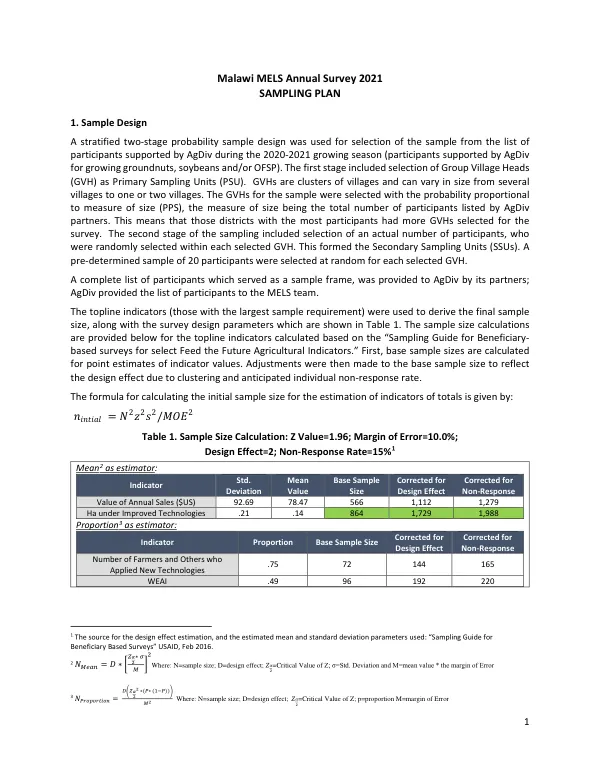
The first stage included the selection of Group Village Heads (GVHs) as Primary Sampling Units (PSUs). GVHs are clusters of villages and can vary in size from several villages to one or two villages. The GVHs for the sample were selected with the probability proportional to measure of size (PPS), the measure of size being the total number of participants listed by AgDiv partners. This means that districts with the most participants had more GVHs selected for the survey. The second stage of the sampling included the selection of an actual number of participants, who were randomly selected within each selected GVH. This formed the Secondary Sampling Units (SSUs). A pre-determined sample of 20 participants were selected at random for each selected GVH. A complete list of participants, which served as a sample frame, was provided to AgDiv by its partners, and AgDiv provided the list of participants to the MELS team. The topline indicators, which have the largest sample requirement, were used to derive the final sample size, along with the survey design parameters. The sample size calculations are provided for the topline indicators calculated based on the "Sampling Guide for Beneficiary-based surveys for select Feed the Future Agricultural Indicators." The formula for calculating the initial sample size for the estimation of indicators of totals is given by: N = D * (Zα/2)^2 * (σ^2 / M^2), where N is the sample size, D is the design effect, Zα/2 is the critical value of Z, σ is the standard deviation, and M is the mean value. The design effect was estimated to be 2, and the non-response rate was anticipated to be 15%. The base sample sizes were calculated for point estimates of indicator values, and adjustments were made to reflect the design effect and non-response rate. The final sample size was determined to be 2,013 farmers, with a total of 100 GVHs selected. The sampling weights were calculated using three components: the first stage weights, which account for the varying probability of GVH selection; the second stage weights, which are simple weights obtained by dividing the total number of listed participants in the GVH by the number of selected participants in that GVH; and the non-response adjustment, which is equal to the selected beneficiaries (respondents + non-respondents) divided by the actual number of beneficiaries. The final weights for the i-th GVH in h-th stratum are calculated as the product of the first stage weight, the second stage weight, and the non-response adjustment. The calculated weights are provided in Table 3, which shows the sampling weights applied for each GVH in each district. The overall probability of selection for each GVH is calculated as the product of the first stage probability of selecting the cluster and the second stage probability of selecting participants. The non-response adjustment is calculated as 1 + m(n)hr / m(r)hr, where m(n)hr is the number of beneficiaries who did not respond in the i-th GVH of h-th stratum, and m(r)hr is the number of beneficiaries who responded in the i-th GVH of h-th stratum. The final sample weight is calculated as the product of the first stage weight, the second stage weight, and the non-response adjustment.
Related documents