USAID DEC
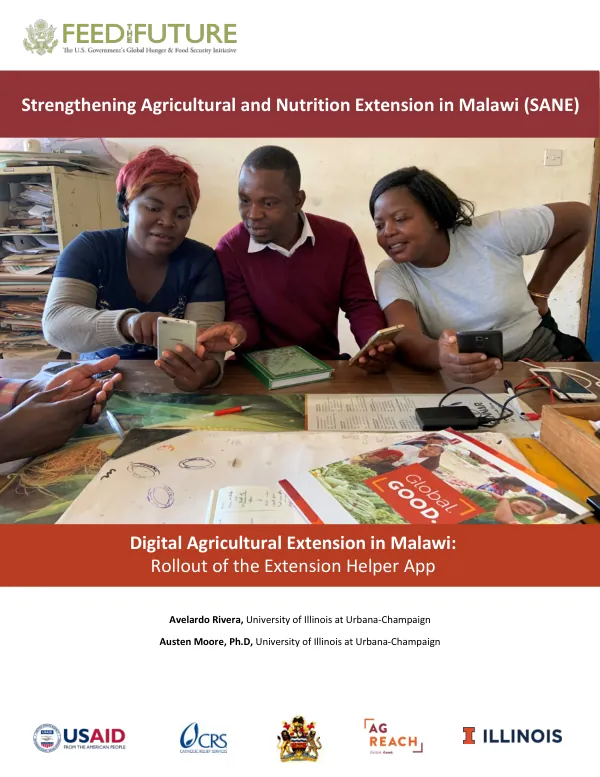
Strengthening Agricultural and Nutrition Extension in Malawi (SANE): Digital Agricultural Extension in Malawi: Rollout of the Extension Helper App
Sign inUNIVERSITY OF ILLINOIS, URBANA-CHAMPAIGN
Strengthening Agricultural and Nutrition Extension in Malawi (SANE): Digital Agricultural Extension in Malawi: Rollout of the Extension Helper App
The Feed the Future (FTF) Malawi Strengthening Agricultural and Nutrition Extension activity (SANE) is a five-year engagement between the University of Illinois at Urbana-Champaign (UIUC) and the United States Agency for International Development (USAID) Malawi.
2019 · 13 pages
Sign in to readA free account is required to download.
Abstract
The Ministry of Agriculture, Irrigation, and Water Development (MoAIWD)'s Department of Agricultural Extension Services (DAES) is the key Government partner. SANE operates in Malawi's 10 Feed the Future (FTF) Expanded Zone of Influence (E-ZOI) districts. The activity focuses heavily on strengthening the implementation of the Government of Malawi's (GoM) National Agricultural Extension Policy (NAEP) and strengthening the District Agricultural Extension Services System (DAESS). DAESS uses a pluralistic Agricultural Innovation Systems approach and relies on the support of diverse stakeholders to function properly. The system has platforms for stakeholder engagement at village, Area, and district levels, including Village Agricultural Committees (VACs), Area Stakeholder Panels (ASPs), District Stakeholder Panels (DSPs), District Agricultural Extension Coordinating Committees (DAECCs), and District Agriculture Committees (DACs). Extension systems in Malawi are becoming increasingly pluralistic, resulting in a variety of actors providing services to farmers. However, diverse actors operating in the same physical space often lack coordination, and some farmers receive more extension services than others. Improving coordination can improve the coverage of extension workers to reach farmers, but is often constrained by basic data on who is doing what, where, and with whom. Extension workers in Malawi are tasked with conducting regular Monitoring and Evaluation (M&E), but this practice is often cumbersome and characterized by poor and subjective data. The National Agricultural Extension Policy (NAEP) encourages the development of stakeholder platforms as a way of aggregating farmers' needs and conveying them from the household level up to district and national levels. However, data collection from stakeholder panel meetings and communications to other levels of the system are often very weak, leading to less-than-ideal implementation of the demand-driven approach. By incorporating mobile technology when collecting and disseminating agricultural information in the field, extension services can rely on data that more clearly shows the activities of different extension actors, resulting in improved coordination, reduced oversaturation of services to some communities, and improved value for money in extension systems. The Extension Helper app was developed to make extension services more accessible and extension systems more efficient for a stronger demand-driven approach. The app is a multi-faceted ICT tool designed to improve extension workers' ability to teach farmers, improve data quality, and improve coordination, efficiency, and cost-effectiveness of services. The app was rolled out in Malawi in collaboration with DAES actors and frontline extension workers, with the guiding principles behind the rollout shown in the Theory of Change (Figure 3). The Theory of Change aligns app functionalities and features to demonstrate the impact pathways associated with the use of the app in extension planning and service provision, that ultimately lead to desired outcomes.