USAID DEC
Memoria del Curso de Formación de Capacidades "Base conceptual para la identificación dendrológica de especies forestales"
Sign inUSAID DEC
Memoria del Curso de Formación de Capacidades "Base conceptual para la identificación dendrológica de especies forestales"
The "Decenio de la igualdad de oportunidades para mujeres y hombres" and "Año de la lucha contra la corrupción y la impunidad" initiatives in Peru are being implemented by the Organismo de Supervisión de los Recursos Forestales y de Fauna Silvestre (OSINFOR).
2020 · 62 pages
Sign in to readA free account is required to download.
Abstract
The OSINFOR is a government agency responsible for supervising the use of forest resources and wildlife in Peru. In 2020, the OSINFOR organized a course on "Base conceptual para la identificación dendrológica de especies forestales" (Conceptual Basis for Dendrological Identification of Forest Species) in collaboration with FOREST, a program of the US Forest Service (USFS) and the United States Agency for International Development (USAID). The course was aimed at strengthening the capacities of forest authorities and wildlife authorities in the Loreto Region of Peru and forest managers in identifying forest species for sustainable forest management. The course was held virtually from September 29 to October 7, 2020, and was attended by forest authorities and wildlife authorities from the Loreto Region and forest managers. The course aimed to address the problem of species identification in the Peruvian Amazon, where there are over 2,500 different forest species, but only around 600 have been properly recognized. The course covered various topics, including the importance of species identification, the complexity of the Amazonian forest ecosystem, and the need for sustainable forest management. The participants were also trained in dendrological identification techniques and were provided with a conceptual basis for identifying forest species. The course was part of the OSINFOR's efforts to strengthen the capacities of forest authorities and wildlife authorities in the Loreto Region and to promote sustainable forest management in the region. The course was also aligned with the OSINFOR's Strategic Plan 2020-2024, which aims to promote the sustainable use and conservation of forest resources and wildlife in Peru. The course was evaluated by the participants, who provided feedback on the course content and methodology. The evaluation results showed that the course was well-received by the participants, who appreciated the opportunity to learn about dendrological identification techniques and to strengthen their capacities in this area. In conclusion, the course on "Base conceptual para la identificación dendrológica de especies forestales" was a successful initiative of the OSINFOR and FOREST to strengthen the capacities of forest authorities and wildlife authorities in the Loreto Region of Peru. The course addressed the problem of species identification in the Peruvian Amazon and provided participants with a conceptual basis for identifying forest species. The course was part of the OSINFOR's efforts to promote sustainable forest management in the region and to address the challenges of species identification in the Amazonian forest ecosystem. The course was well-received by the participants, who appreciated the opportunity to learn about dendrological identification techniques and to strengthen their capacities in this area. The OSINFOR's efforts to promote sustainable forest management in the region are aligned with the government's initiatives to promote the sustainable use and conservation of forest resources and wildlife in Peru. The course is an example of the OSINFOR's commitment to promoting sustainable forest management and to addressing the challenges of species identification in the Amazonian forest ecosystem. The course also highlighted the importance of collaboration between government agencies, international organizations, and local stakeholders in promoting sustainable forest management and addressing the challenges of species identification in the Amazonian forest ecosystem. The course was a successful example of collaboration and partnership in promoting sustainable forest management in the region. The course also provided an opportunity for the participants to share their experiences and best practices in dendrological identification and to learn from each other. The course was a platform for knowledge sharing and capacity building, and it provided an opportunity for the participants to strengthen their capacities in dendrological identification and to promote sustainable forest management in the region.
Related documents
Documents in this collection
 2022
2022USAID DEC
Consultoría para brindar asistencia técnica para la implementación de un sistema de seguimiento estratégico en el OSINFOR
Open record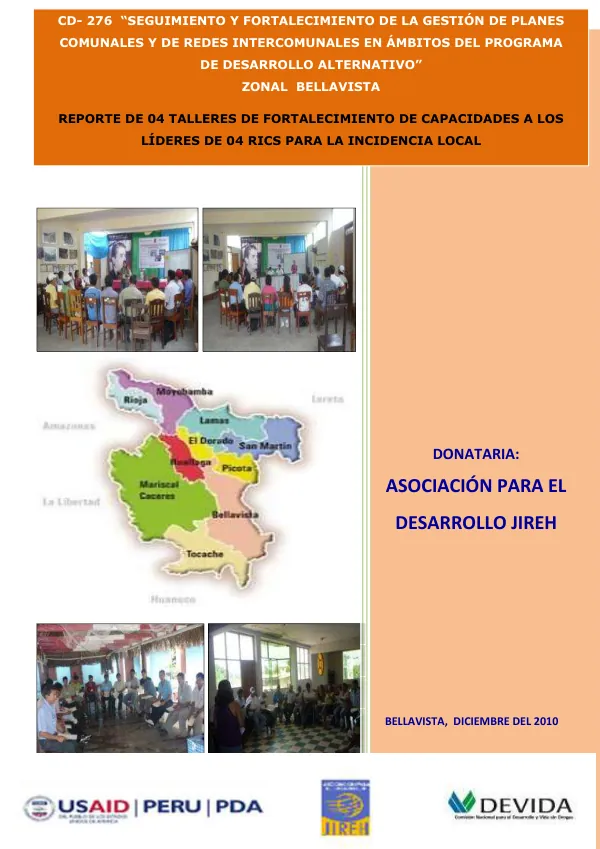 2010
2010USAID DEC
SEGUIMIENTO Y FORTALECIMIENTO DE LA GESTIÓN DE PLANES COMUNALES Y DE REDES INTERCOMUNALES EN ÁMBITOS DEL PROGRAMA DE DESARROLLO ALTERNATIVO
Open record