USAID DEC
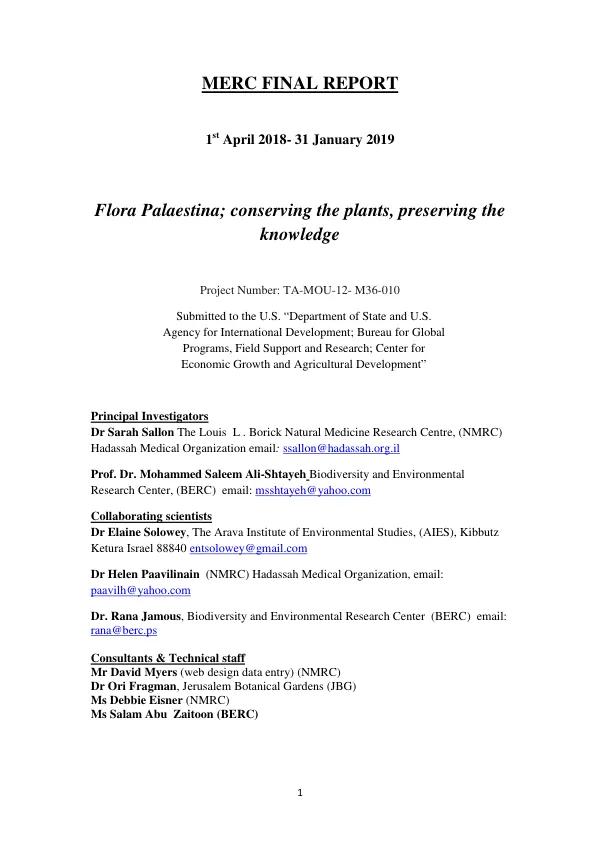
MERC FINAL REPORT: Flora Palaestina; conserving the plants, preserving the knowledge
Sign inUSAID DEC
MERC FINAL REPORT: Flora Palaestina; conserving the plants, preserving the knowledge
The Flora Palaestina project aimed to conserve the plants and preserve the knowledge of their traditional and historical uses in the region of Israel, Palestine, and Jordan.
2019 · 39 pages
Sign in to readA free account is required to download.
Abstract
The project was conducted by a joint collaboration between Israeli and Palestinian researchers from the Natural Medicine Research Centre (NMRC) at Hadassah Medical Organization, the Biodiversity and Environmental Research Centre (BERC) in Nablus, and the Arava Institute of Environmental Studies (AIES) at Kibbutz Ketura, Israel. The project had two major objectives. Firstly, to construct an ethnobotanical website of Flora Palaestina species found in the region, in English, based on their historic uses. Secondly, to select and propagate individual Flora Palaestina species with real economic potential based on these historic uses. The researchers obtained information from source material previously collected by BERC and NMRC, including surveys of plant use by the local Palestinian population and an archival collection in Hebrew of local plant use in Israel. The ethnobotanical website was designed to be user-friendly and informative, providing unique descriptions of both historical/traditional uses and modern medical applications in separate but related fields. The website also included search engines for individual species, complaints, other uses, and medical actions. The construction of the database took longer than originally estimated, and a non-funded extension of the program was requested and initially approved but later cancelled due to exceptional circumstances. In the second objective, propagation of more than 30 species by BERC and AIES was completed, providing a valuable germplasm collection for domestication, conservation, and cultivation purposes. The project aimed to evaluate the plants of Flora Palaestina for their economic potential based on ethno-botanical use as well as existing phytochemical research data. The Flora Palaestina project is important to development as it addresses the conservation of the region's plant species and the preservation of traditional knowledge. The project also aims to promote economic development by evaluating the economic potential of the plants and domesticating and conserving genetic diversity of selected wild species. The project's innovative aspects include the collaboration between Israeli and Palestinian researchers and the use of ethnobotanical data to evaluate the economic potential of the plants. The project was supported by other organizations, including the U.S. Department of State and the U.S. Agency for International Development (USAID), which provided funding for the project. The project's outcomes are expected to be a source of useful, informative, and unique data on the plants of the region, helping to conserve them for future generations and bringing together all those interested and committed to preserving this valuable and historic legacy. The project's methodology involved the construction of an ethnobotanical website, the selection and propagation of individual Flora Palaestina species, and the evaluation of the plants for their economic potential. The project's results include the completion of the database and the propagation of more than 30 species. The project's future work includes the final edit of all species and the loading of the material into the website, which is expected to be fully functional in late 2019. The project's geographic focus is on the region of Israel, Palestine, and Jordan, which contains almost 3000 plant species growing in desert, Mediterranean, subtropical, and mountainous terrain. The project's timeframes are from October 2016 to January 2019, with a non-funded extension of the program requested and initially approved but later cancelled due to exceptional circumstances.