NEAR EAST FOUNDATION
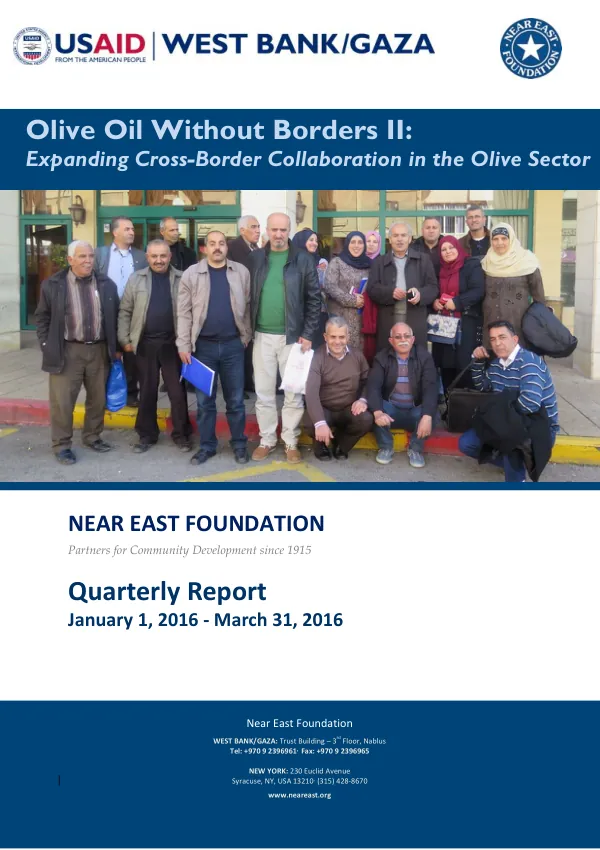
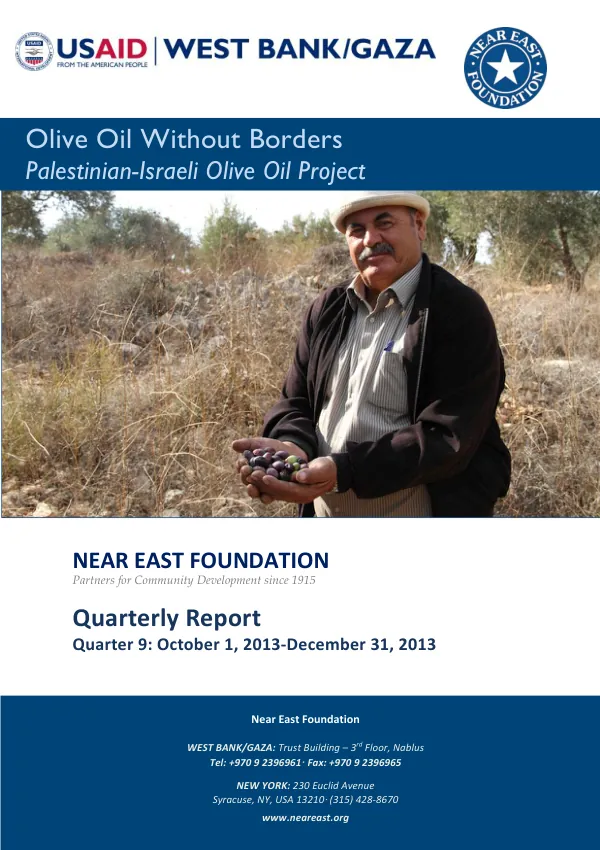
Olive Oil Without Borders: Palestinian-Israeli Olive Oil Project
The Olive Oil Without Borders: Palestinian-Israeli Olive Oil Project began in 2018 with funding from the United States Agency for International Development (USAID).
41 pages
Sign in to readA free account is required to download.
Abstract
The project aimed to strengthen grassroots, cross-border economic cooperation between Israelis and Palestinians. Initial assessments identified soil degradation and limited market access as primary challenges in the olive oil industry. Implementation focused on three key objectives: strengthening grassroots, cross-border economic cooperation; leveraging cross-border economic cooperation to promote peace and reconciliation; and building capacity of local institutions to scale up opportunities and conditions for cross-border cooperation. Activities included project launch, value chain framework development, cross-border value chain analysis, facilitation of dialogue through "Whole-System-in-a-Room" (WSR) workshops, and training of trainers. Farmer Field Schools (FFS) were established to promote sustainable agriculture practices and improve crop yields. The project also facilitated peer-to-peer training in 34 communities, with a focus on women-headed households. Site visits were conducted in Israel to assess the quality of olive oil production and facilitate upgrades to six olive oil mills. The project's second objective aimed to leverage cross-border economic cooperation to promote peace and reconciliation. Activities included documentation and guidance of the reconciliation process, adaptation of the value chain framework to a cross-border conflict and reconciliation context, and incorporation of conflict management and mitigation into training curriculum. The third objective focused on building capacity of local institutions to scale up opportunities and conditions for cross-border cooperation. Activities included identifying and prioritizing potential policy issues, broadening support through strategic communications, and monitoring and evaluation. The project's progress was monitored through regular reporting and evaluation. The Near East Foundation (NEF) implemented the project, with support from USAID. The project's success was measured through indicators such as increased household income, improved food security, and enhanced cross-border cooperation. The project's activities were carried out in collaboration with local institutions, including the Palestinian Center for Agriculture Researches and Development (PCARD) and the Peres Center for Peace (PCP). The project's impact was assessed through regular monitoring and evaluation, with a focus on measuring progress against the workplan and identifying lessons learned. The Olive Oil Without Borders project demonstrated the potential for cross-border economic cooperation to promote peace and reconciliation between Israelis and Palestinians. The project's activities and outcomes highlighted the importance of building capacity of local institutions and promoting sustainable agriculture practices. The project's success was made possible through the generous support of the American people through USAID.
Related documents