CARE
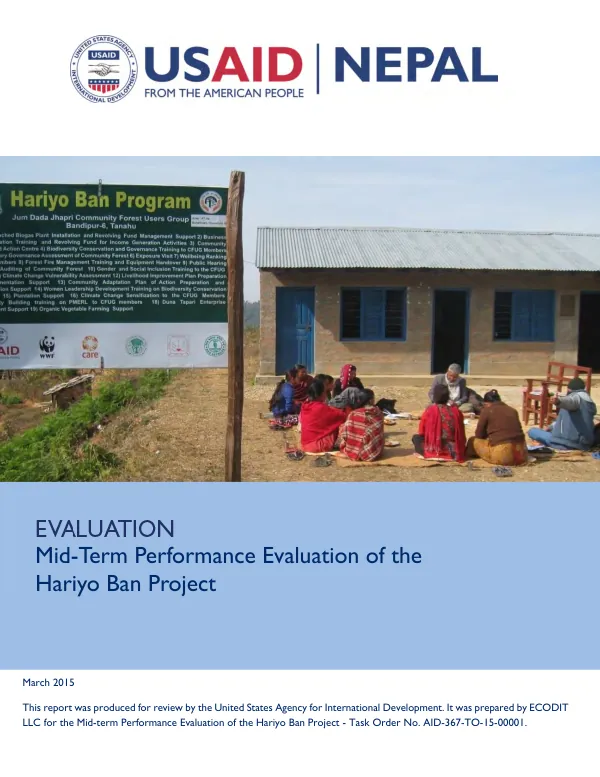
Mid-Term Performance Evaluation of the Hariyo Ban Project
The Hariyo Ban Project is a USAID-funded initiative aimed at promoting sustainable natural resource management and climate change adaptation in Nepal.
2015 · 129 pages
Sign in to readA free account is required to download.
Abstract
The project was launched in 2014 and is being implemented in the Chitwan-Annapurna Landscape (CHAL) and the Terai Arc Landscape (TAL). The project's primary objective is to reduce greenhouse gas emissions and promote sustainable forest management practices. The project's implementation area covers 12 districts in the CHAL and TAL, with a total population of approximately 3.5 million people. The project is being implemented by a consortium of local and international organizations, including the Federation of Community Forest User Groups Nepal (FECOFUN), the World Wildlife Fund (WWF), and the International Union for Conservation of Nature (IUCN). The Hariyo Ban Project focuses on several key areas, including community-based natural resource management, climate change adaptation, and sustainable forest management. The project aims to promote the adoption of sustainable forest management practices among local communities, reduce deforestation and forest degradation, and promote the conservation of biodiversity. The project's approach is based on a participatory governance framework, which involves the active participation of local communities, government agencies, and other stakeholders in the decision-making process. The project also focuses on building the capacity of local communities and government agencies to manage natural resources sustainably and adapt to climate change. The Hariyo Ban Project has made significant progress in its first two years of implementation. The project has established 15 community forest user groups, which have been trained in sustainable forest management practices and are now managing over 10,000 hectares of forest land. The project has also established a network of community-based anti-poaching units, which are working to prevent wildlife poaching and habitat degradation. The project's midterm evaluation report highlights several key findings and recommendations. The report notes that the project has made significant progress in promoting sustainable forest management practices and reducing deforestation and forest degradation. However, the report also notes that the project faces several challenges, including limited capacity among local communities and government agencies to manage natural resources sustainably and adapt to climate change. The report recommends that the project focus on building the capacity of local communities and government agencies to manage natural resources sustainably and adapt to climate change. The report also recommends that the project establish a more robust monitoring and evaluation system to track progress and identify areas for improvement. Overall, the Hariyo Ban Project is making significant progress in promoting sustainable natural resource management and climate change adaptation in Nepal. However, the project faces several challenges, and it will be important for the project to focus on building the capacity of local communities and government agencies to manage natural resources sustainably and adapt to climate change.