USAID DEC
Mid-Term Performance Evaluation of the USAID/Egypt Strengthening Entrepreneurship and Enterprise Development (SEED) Project
Sign inQED GROUP, LLC
Mid-Term Performance Evaluation of the USAID/Egypt Strengthening Entrepreneurship and Enterprise Development (SEED) Project
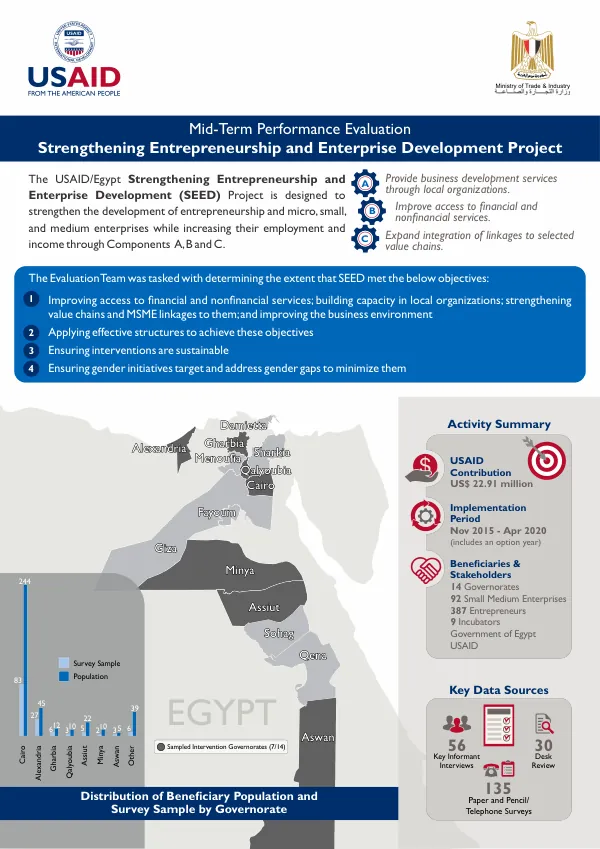
The Strengthening Entrepreneurship and Enterprise Development (SEED) Project in Egypt is a USAID-funded initiative aimed at strengthening entrepreneurship and micro, small, and medium enterprises (MSMEs) while increasing their employment and income.
2019 · 2 pages
Sign in to readA free account is required to download.
Abstract
The project operates through three components: A, B, and C, with a focus on improving access to financial and non-financial services, building capacity in local organizations, and strengthening value chains and MSME linkages to them. The project targets 14 governorates, with a focus on sampled intervention governorates, including Cairo, Alexandria, Gharbia, Qalyoubia, Assiut, Minya, and Aswan. The project has a total budget of US$ 22.91 million, with USAID contributing US$ 22.91 million. The project duration is from November 2015 to April 2020, with an option year. The project's main objectives are to provide business development services through local organizations, improve access to financial and non-financial services, and expand integration of linkages to selected value chains. The project has achieved significant results, including the establishment of 9 incubators, training of 387 entrepreneurs, and support to 92 small and medium enterprises. The mid-term performance evaluation of the project reveals several key findings and recommendations. Firstly, surveyed entrepreneurs rate increased access to incubator capacity building training as very useful and practical, but indicate that the capacity building materials are too generic for continued use beyond the startup phase. Recommendation 1a suggests that SEED should develop progressively advanced materials for use with incubators and service providers at different stages in support of the entrepreneurial growth and development life cycle. Secondly, commercial business development service (BDS) providers with development mindsets have not yet been effectively leveraged. Recommendation 1b suggests that SEED should expand access to financial services through commercial BDSs and target development-minded private sector providers and NGOs offering non-financial services. Thirdly, surveyed entrepreneurs rate funding, networking, e-marketing/e-commerce, and value chain linkages as the most important services needed to grow their business. Recommendation 2 suggests that SEED should increase efforts to support entrepreneurs' stated priority needs for increased access to funding, networking, e-marketing/e-commerce services, and value chain linkages. Fourthly, surveyed entrepreneurs rate matchmaking activities and business mentors and advisors as highly needed to very highly needed. Recommendation 3 suggests that SEED should expand activities to engage participants in pre and post-event mentorship activities. Lastly, the project has achieved success in adding planning capacity to three promising women's groups, including the Women's Entrepreneurs' Network (WEN), but all are still in the early stages of development and require strengthening. Recommendation 4 suggests that SEED should continue efforts to mentor and establish the Women's Entrepreneurs' Network with a sustainable business model, emphasizing gender gap reduction and a broader service mix for members linking activities with SEED Components A through C. The project's findings also reveal that beneficiaries outside of Cairo and Alexandria governorates express higher levels of unmet needs. Recommendation 5 suggests that future USAID program designs should emphasize the need for a regional office structure or strategic regional alliances with clear selection criteria.