USAID DEC
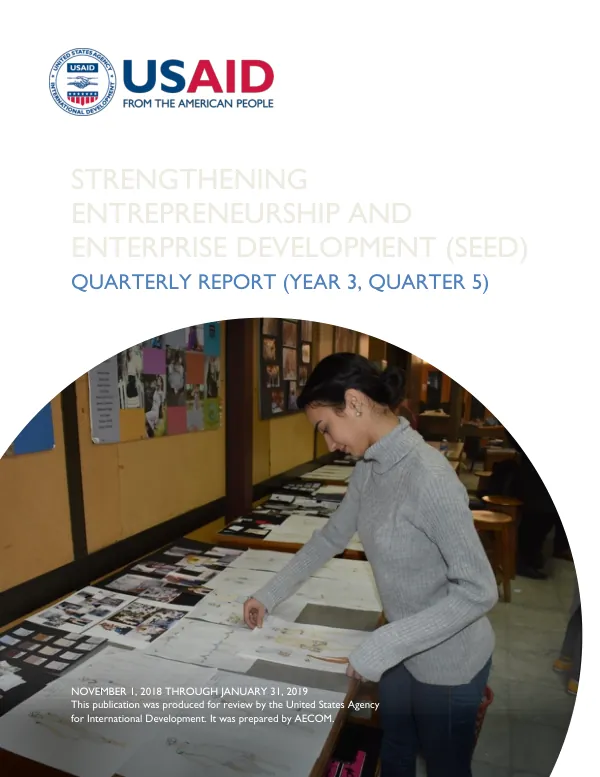
Strengthening Entrepreneurship and Enterprise Development (SEED) Quarterly Report (Year 3, Quarter 5)
Sign inUSAID
Strengthening Entrepreneurship and Enterprise Development (SEED) Quarterly Report (Year 3, Quarter 5)
The USAID SEED project in Egypt aimed to stimulate and improve entrepreneurship skills and opportunities across the country.
2018 · 26 pages
Sign in to readA free account is required to download.
Abstract
Key achievements to date include the provision of 3,106 new and better employment opportunities through SEED-supported partners, including incubators, one-stop shops, and micro, small, and medium-sized enterprises (MSMEs). These partners generated $2,493,665 in revenues, with $1,516,708 attributed to USAID SEED support. A total of 744 entrepreneurs were supported to launch or grow their business models, and 2,793 people accessed mentorship programs. Additionally, 9,981 females participated in USAID SEED-assisted programs designed to increase access to productive economic resources. Financial literacy programs were delivered to 744 MSME managers and entrepreneurs, and 8,710 clients benefited from financial services provided through SEED-assisted financial intermediaries. To stimulate entrepreneurship skills and opportunities, the project conducted or established 9 business plan competitions and 6 start-up weekends, 2 career fairs, 24 entrepreneurship workshops, 12 incubators in 6 governorates, and 6 capacity-building workshops for technology transfer offices (TTOs). The project also delivered 2 workshops on leadership and financial literacy to the Technology Innovation and Entrepreneurship Center (TIEC) and introduced a new entrepreneurship and financial literacy program to 15 high schools and 10 universities across Egypt. To improve financial and non-financial services to MSMEs, the project conducted or established 4 improved one-stop-shop (OSS) centers, 13 trainings to potential business development service (BDS) providers, 8 new BDS centers in 7 governorates, 6 investment linkages forums, and 7 training of trainers (TOT) financial literacy sessions to microfinance institutions and partners. The project also established a new OSS center in Shoubra El Khema. The USAID SEED project has made significant progress in stimulating entrepreneurship skills and opportunities across Egypt, with a focus on improving financial and non-financial services to MSMEs. The project's achievements demonstrate its commitment to supporting the growth and development of MSMEs in Egypt. The project's geographic focus is on Egypt, with a specific emphasis on the five selected value chains: ready-made garments, plastics, dairy, fishery, and automotive. The project's timeframes are quarterly, with a focus on achieving key milestones and outcomes. The project's recommendations for future implementation include continuing to support the growth and development of MSMEs, improving financial and non-financial services to MSMEs, and increasing access to productive economic resources for females. The project also recommends continuing to conduct business plan competitions, start-up weekends, and entrepreneurship workshops, as well as establishing new incubators and OSS centers. The project's cross-cutting activities include gender and youth, enabling environment, communications and marketing, and information and communication technology (ICT). The project's monitoring and evaluation activities include tracking key performance indicators (KPIs) and conducting regular assessments to ensure the project is meeting its objectives. The project's lessons learned for future implementation include the importance of building strong relationships with stakeholders, including government agencies, private sector companies, and civil society organizations. The project also recommends continuing to support the development of MSMEs, particularly in the areas of financial literacy and access to markets.