PLAN INTERNATIONAL
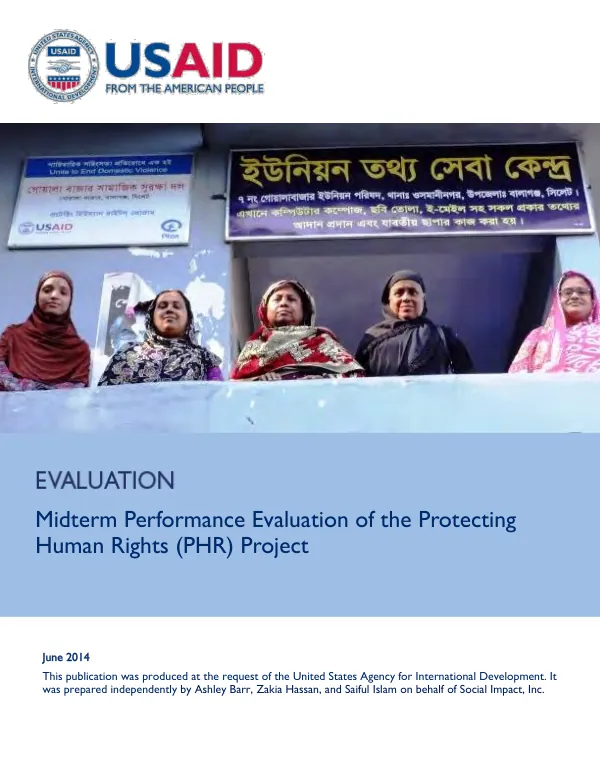
Midterm Performance Evaluation of the Protecting Human Rights (PHR) Project
The Protecting Human Rights (PHR) Project in Bangladesh aims to address violence against women (VAW) and gender-based violence (GBV) through the implementation of the Domestic Violence (Prevention and Protection) Act (2010) and its Rules (2013).
2014 · 102 pages
Sign in to readA free account is required to download.
Abstract
The project, implemented by Plan International in partnership with the Government of Bangladesh, began in March 2011 with funding from the United States Agency for International Development (USAID). The project's development hypothesis is that better implementation of the Domestic Violence Act and its Rules, coupled with normative changes in attitudes and behavior among citizens and officials, will lead to a decline in domestic violence (DV). The project's objectives are highly relevant, and USAID's investments in addressing DV and its root causes are well-advised. The midterm evaluation of the PHR Project was conducted to provide information about what aspects of the project are working well and should be continued, as well as recommendations for ways in which the project might be improved. The evaluation was based on a review of Government of Bangladesh policies and laws, PHR project documents, and extensive interviews and group discussions with stakeholders in Dhaka and selected project districts, upazilas, and union parishads (UPs), including women experiencing violence at home. The evaluation team found that the PHR implementing team lacks senior gender expertise and does not involve International Centre for Research on Women (ICRW) and Bangladesh National Women Lawyers' Association (BNWLA) gender experts in project decision making. Small group discussions with a range of PHR stakeholders revealed that the project's approach has the potential to be even more relevant, prominent, and sustainable with refinements. The evaluation team also found that the project has made progress in addressing DV and its root causes, including the establishment of One-Stop Crisis Centers (OCCs) and the provision of legal and other services to victims of DV. However, the project faces challenges in terms of limited resources, inadequate infrastructure, and a lack of coordination among stakeholders. The evaluation team recommends that the PHR Project be refined to include senior gender expertise and involve ICRW and BNWLA gender experts in project decision making. The project should also prioritize the establishment of OCCs and the provision of legal and other services to victims of DV. Additionally, the project should focus on building the capacity of stakeholders, including government officials, law enforcement personnel, and community leaders, to address DV and its root causes. The evaluation team also recommends that the project be expanded to include a greater focus on addressing the root causes of DV, including poverty, lack of education, and social norms that perpetuate violence against women. The project should also prioritize the involvement of men and boys in addressing DV and its root causes, as well as the empowerment of women and girls to assert their rights and seek help when experiencing violence. Overall, the PHR Project has the potential to make a significant impact in addressing DV and its root causes in Bangladesh. However, refinements to the project's approach and a greater focus on addressing the root causes of DV are necessary to ensure the project's sustainability and impact.