UNICEF
MIHR RED-REC in Fragile Settings
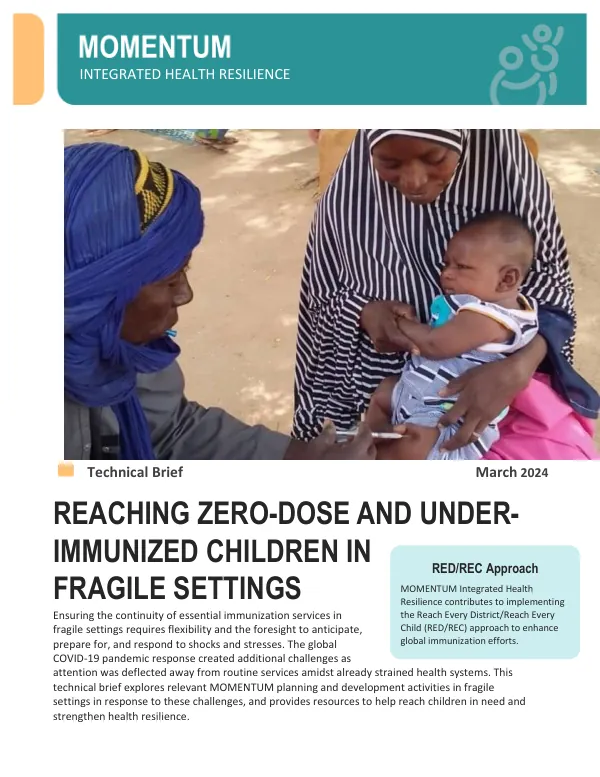
The global COVID-19 pandemic response created additional challenges for fragile settings, deflecting attention away from routine immunization services amidst already strained health systems.
2024 · 14 pages
Sign in to readA free account is required to download.
Abstract
In response, MOMENTUM Integrated Health Resilience (MIHR) is taking a proactive approach to accelerate post-pandemic immunization catch-up and recovery in partner countries. MIHR's country partners are adapting and using the Reaching Every District/Reaching Every Child (RED/REC) approach to build more resilient, sustainable, and equitable immunization services in settings affected by conflict and other environmental and man-made shocks and stresses. The RED/REC approach was developed by WHO and partners in the early 2000s and is implemented by countries to strengthen their immunization programs and improve equity. The five components of the RED/REC approach align with health system strengthening elements, including community engagement, data-driven decision-making, and supply chain management. In the Africa region, the RED/REC approach has been adapted using the 2017 Reaching Every District (RED) guide, which provides a framework for increasing immunization coverage. Routine immunization services in fragile settings are a foundation of child health and well-being, and a vital entry point to primary health care services. Zero-dose children, those who have not received a single dose of the diphtheria-tetanus-pertussis (DTP) vaccine, are especially vulnerable to illness and death from vaccine-preventable diseases. In response to the COVID-19 pandemic, immunization coverage has partially recovered, but remains below 2019 levels. WHO and UNICEF estimates for 2022 coverage found that more than 20.5 million children still missed out on one or more vaccines, and over 14.3 million missed out on DPT1. MOMENTUM Integrated Health Resilience works with partner countries in fragile and conflict-affected settings to strengthen basic immunization services for women and children as part of maternal, newborn, and child health (MNCH), voluntary family planning (FP), reproductive health (RH), and nutrition services. MIHR focuses on strengthening health resilience, including the preparedness of local health systems, health facilities, health care providers, communities, households, and individuals to deliver quality health information and services in times of calm but also during conflicts, disasters, and other shocks and stresses. To reach zero-dose and under-immunized children and their family members with immunization and other essential primary health care services, MIHR works strategically with its country partners to adapt and leverage the RED/REC approach in fragile settings. This involves assessing and strengthening subnational health systems and community capacities that are key during shocks and stresses to RED/REC and the continuity of immunization and other primary health care services. Additionally, MIHR integrates elements of emergency preparedness and response planning with immunization microplanning, a cornerstone of the RED/REC approach. MIHR's holistic approach to strengthening the resilience capacities of health systems, communities, and households considers risk awareness and surveillance; emergency preparedness, response, and recovery; and system transformation (through broader health and social sector development) to prevent future crises and facilitate faster recovery when they do occur. By working strategically with its country partners, MIHR aims to increase coordination and collaboration among actors, including government, humanitarian, development, public, private, national, and local, to bridge the divide between humanitarian and development assistance.
Related documents