CENTER FOR EDUCATIONAL DEVELOPMENT
MINDANAO YOUTH FOR DEVELOPMENT (MYDEV) PROGRAM PHILIPPINES
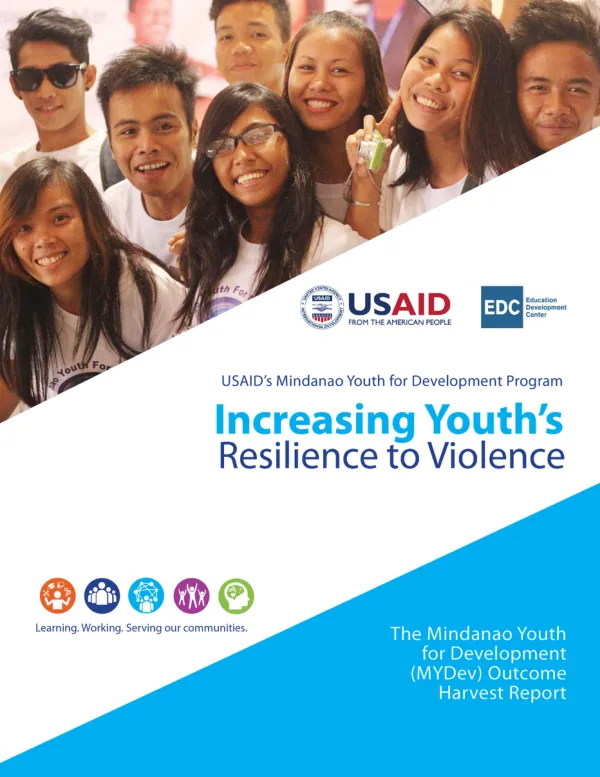
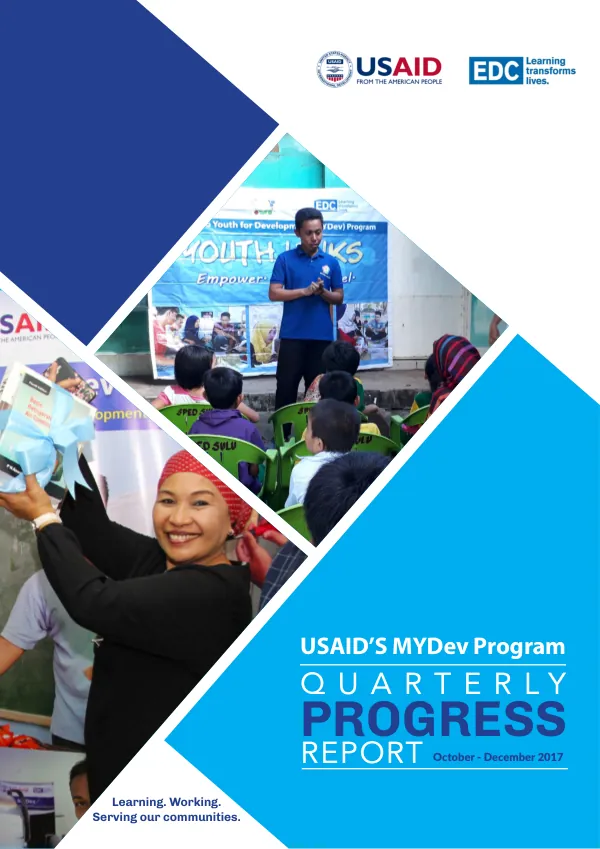
The Mindanao Youth for Development (MYDev) program in the Philippines was a USAID-funded initiative implemented by the Education Development Center (EDC) from 2013 to 2019.
2021 · 5 pages
Sign in to readA free account is required to download.
Abstract
The program aimed to address key constraints to peace and stability in the Mindanao region by strengthening governance, improving life skills, and increasing civic engagement and economic productivity of out-of-school youth. The program was implemented in eight conflict-affected areas of the Mindanao region, which has long struggled with ongoing conflict between the government and terrorist, rebel, and criminal groups. In 2017, the city of Marawi experienced a five-month long violent crisis, resulting in the displacement of thousands of citizens and considerable damage to infrastructure and private property. The major components of MYDev included life skills instruction, technical skills training through the Technical Education and Skills Development Authority (TESDA), support for equitable access to basic education and high school equivalency courses through the Department of Education's Alternative Learning System (ALS), and capacity building through the creation of local out-of-school youth development alliances (YDAs). The program's life skills instruction was conceptualized as SEL skills, which were defined as work readiness skills necessary for young people to be successful at work and civic engagement skills including values, attitudes, knowledge, and skills that enable young people to think critically and act creatively for personal, community, and national development. The program's objectives, activities, and outcomes were guided by the activity's development hypothesis that conflict-affected communities will begin to benefit from the accretion of social capital that underpins local area stability, security, and prosperity when the social contract between local government, communities, and vulnerable out-of-school youth is strengthened through incremental gains in mutual trust. The program's Life Skills Training consisted of nine modules and culminated in community service projects that youth manage and plan as a way to apply learned skills and attitudes from the training. The program also partnered with ALS to increase vulnerable youth's access to education and with TESDA to enhance their employability. Another central feature of the Life Skills Training was the civic engagement module, which was designed to inspire youth to be actively involved in their communities. The program's implementation was characterized by a thorough contextualization process that took into account local perspectives, values, and existing teaching and learning materials from ALS and TESDA. The activity was conceptualized in conjunction with key stakeholders such as ALS, TESDA, local government officials, and private sector representatives, all of whom reviewed and validated learning content and activities. The program's equity and inclusion of youth was a key consideration, particularly since the main target population comprised vulnerable and out-of-school youth. Youth with disabilities and youth in remote areas were also targeted for programming. One noted benefit of the activity was the way in which views and priorities of out-of-school youth were represented and given weight through the structure of YDAs. The program's implementation and measurement plan were rigorous and well-triangulated. Continuous engagement and intentional capacity building with the government in all activity aspects allowed for curriculum scale-up beyond the initial target regions. Respondents and activity materials alike noted a great interest in activity offerings on the part of the government and local enterprises, acknowledging that MYDev was able to meet an important gap in services. The program's strong relationship with USAID was identified as a key ingredient of activity success. USAID's focus on measuring success and translating findings was also seen as a key factor enabling scale-up in the Philippines and global recognition of the activity's success. The USAID Mission played a very active and collaborative role in activity roll-out and throughout the life of MYDev. The program's measurement plan included regular dynamic monitoring and feedback given by key informants, which provided evidence of activity success. The program's Life Skills materials and approach developed by MYDev are now being used in other areas of the Philippines and in other countries as part of youth development activities.