USAID DEC
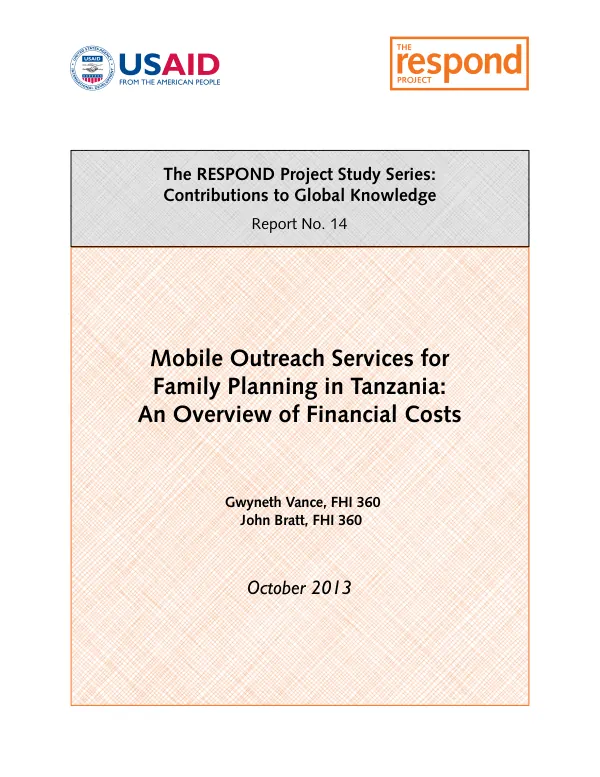
Mobile Outreach Services for Family Planning in Tanzania: An Overview of Financial Costs
Sign inFHI 360
Mobile Outreach Services for Family Planning in Tanzania: An Overview of Financial Costs
The agricultural development initiative in Tanzania began in 2013 with funding from the U.S.
2013 · 29 pages
Sign in to readA free account is required to download.
Abstract
Agency for International Development (USAID) through the RESPOND Project. The study focused on the financial costs of mobile outreach services for family planning in Tanzania. The research was conducted by Gwyneth Vance and John Bratt of FHI 360, in collaboration with the RESPOND Project. The study took place in Tanzania, where the Ministry of Health and Social Welfare (MOHSW) has implemented mobile outreach services for family planning. The Marie Stopes International/Tanzania (MST) organization was selected as the case study for this research. MST's mobile services model involves mobile teams that travel to rural areas to provide family planning services. The study used a combination of data sources, including data from MST's mobile outreach teams and expeditions. The data analysis focused on the costs associated with providing family planning services, including the costs of contraceptive supplies and expendable supplies. The study also examined the relationship between the number of clients served and the costs associated with providing family planning services. The results of the study showed that the average cost per client for MST's mobile outreach services was approximately $10. The costs of contraceptive supplies and expendable supplies accounted for a significant portion of the total costs. The study also found that the number of clients served was positively correlated with the average cost per client. The study made several recommendations to improve the cost efficiency of mobile outreach services for family planning in Tanzania. These recommendations included streamlining the service delivery process, reducing the costs of contraceptive supplies and expendable supplies, and increasing the number of clients served per outreach team. The study also suggested that different outreach models should be compared to determine which one is most cost-effective. The study concluded that mobile outreach services for family planning in Tanzania are a cost-effective way to provide family planning services to rural populations. The study's findings have implications for the design and implementation of mobile outreach services for family planning in Tanzania and other countries. The study's recommendations can be used to improve the efficiency and effectiveness of mobile outreach services for family planning in Tanzania.