USAID DEC
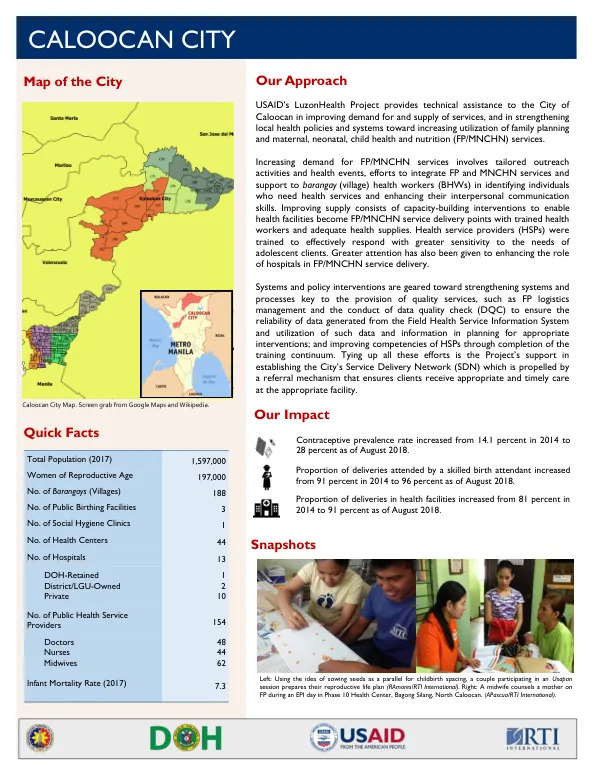
USAID’s LuzonHealth Project: Improving Demand for and Supply of Family Planning and Maternal, Neonatal, Child Health and Nutrition (FP/MNCHN) Services in Caloocan City
Sign inRTI INTERNATIONAL
USAID’s LuzonHealth Project: Improving Demand for and Supply of Family Planning and Maternal, Neonatal, Child Health and Nutrition (FP/MNCHN) Services in Caloocan City
The City of Caloocan in the Philippines has a population of 1,597,000, with 197,000 women of reproductive age.
2018 · 2 pages
Sign in to readA free account is required to download.
Abstract
The city has 188 barangays, or villages, and a total of 154 public health service providers, including 48 doctors, 44 nurses, and 62 midwives. The infant mortality rate in Caloocan City was 7.3 per 1,000 live births in 2017. The USAID LuzonHealth Project provides technical assistance to the City of Caloocan to improve demand for and supply of family planning and maternal, neonatal, child health and nutrition (FP/MNCHN) services. The project aims to increase the contraceptive prevalence rate, improve the proportion of deliveries attended by a skilled birth attendant, and increase the proportion of deliveries in health facilities. To increase demand for FP/MNCHN services, the project conducts tailored outreach activities and health events, integrates FP and MNCHN services, and supports barangay health workers in identifying individuals who need health services and enhancing their interpersonal communication skills. The project also trains health service providers to effectively respond to the needs of adolescent clients. To improve supply, the project provides capacity-building interventions to enable health facilities to become FP/MNCHN service delivery points with trained health workers and adequate health supplies. The project also supports the training of health service providers in various skills, including basic emergency obstetric and newborn care, family planning, and supply management. The project also focuses on strengthening systems and processes key to the provision of quality services, particularly health information systems, FP logistics management, and health financing. All 44 health centers in the city are regularly conducting data quality checks, and there are now 66 FP service delivery points in the city, providing FP counseling and services. The project has established a Service Delivery Network (SDN) in Caloocan City, which is a network of health facilities propelled by a referral mechanism that ensures clients receive appropriate and timely care at the appropriate facility. The SDN has 59 member-facilities, and representatives from member-facilities, the Caloocan City Government, and partner agencies attended the SDN Summit in January 2017. As a result of the project's interventions, the contraceptive prevalence rate in Caloocan City increased from 14.1 percent in 2014 to 28 percent as of August 2018. The proportion of deliveries attended by a skilled birth attendant increased from 91 percent in 2014 to 96 percent as of August 2018, and the proportion of deliveries in health facilities increased from 81 percent in 2014 to 91 percent as of August 2018. The project's success is attributed to the open communication and professional relationships fostered among all member-facilities, which ultimately translate to better health services for the people. The project's interventions have been institutionalized and sustained, and the City's MNCHN Coordinator notes that establishing the network has been a transformational experience, realizing that the issues they face are interconnected and better solved by working together.
Related documents
Documents in this collection
 2018
2018USAID DEC
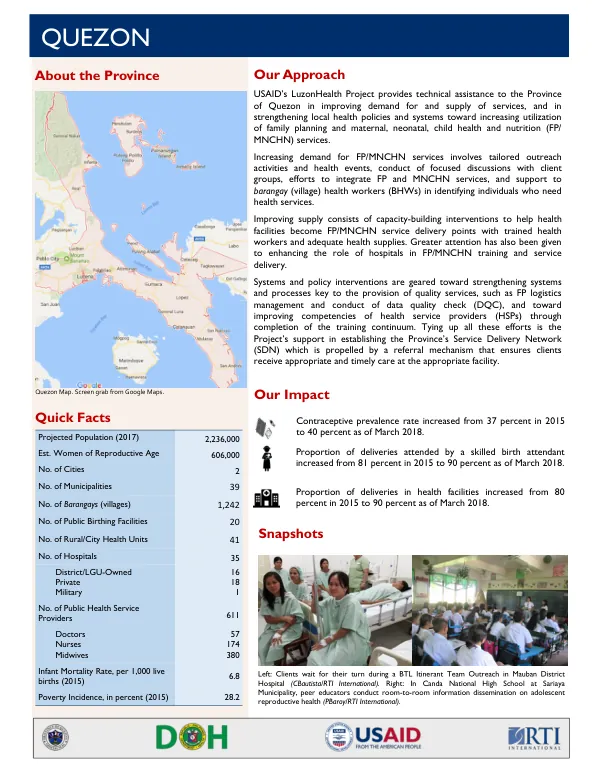
USAID’s LuzonHealth Project: Improving Demand for and Supply of Family Planning and Maternal, Neonatal, Child Health and Nutrition (FP/MNCHN) Services in the Province of Quezon
Open record 2018
2018USAID DEC