DEPARTMENT OF HEALTH
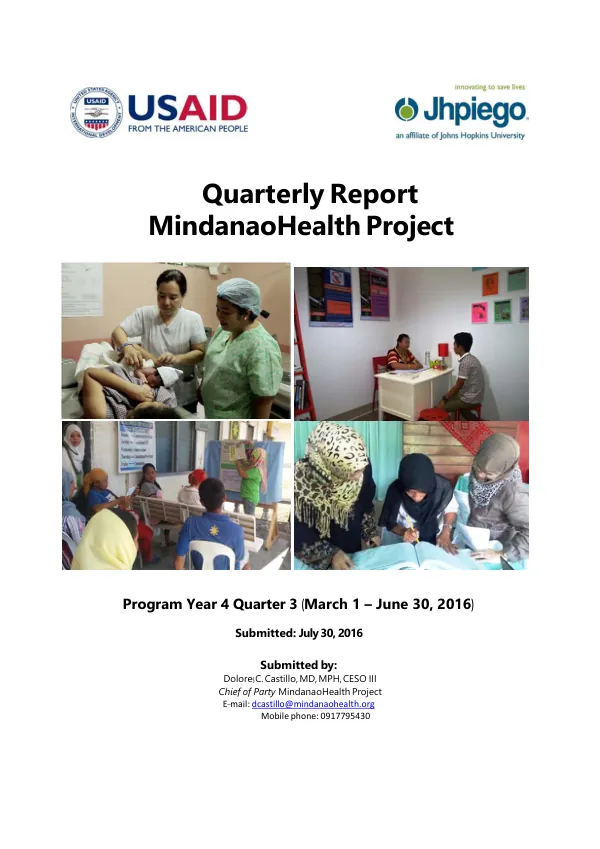
MindanaoHealth Project: Final Report (2013-2018)
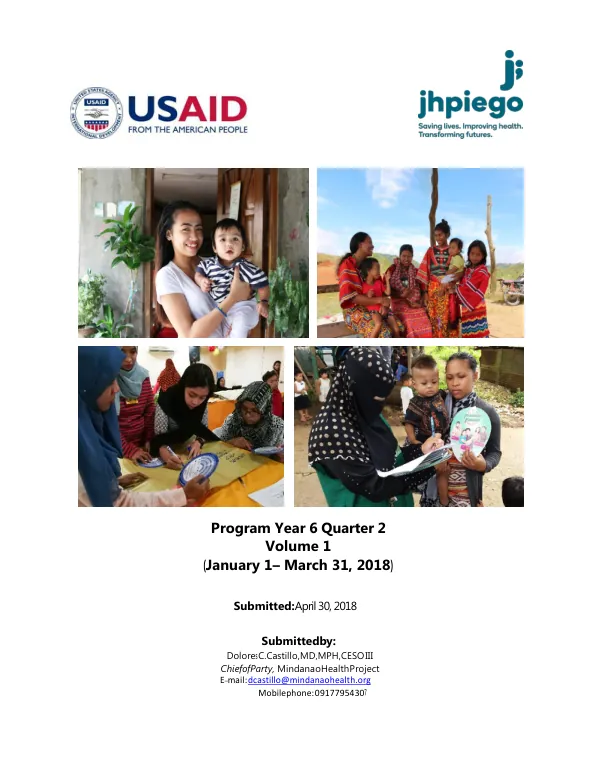
The MindanaoHealth (MH) Project, implemented by Jhpiego in partnership with RTI International, aims to improve family health in Mindanao by increasing the quality and uptake of integrated maternal, newborn, child health and nutrition, and family planning (MNCHN/FP) services.
2018 · 225 pages
Sign in to readA free account is required to download.
Abstract
The project's goal is to reduce maternal and infant deaths, decrease unmet need for FP services, and improve child health and nutrition, particularly among the lowest wealth quintiles and in conflict-affected areas. MH collaborates with the Department of Health (DOH) to scale up high-impact services, including client-centered approaches by providers. The project works directly with six DOH-regional health offices and has forged partnerships with 19 provinces, two cities, and 368 municipalities to help the government achieve its commitment to reduce maternal and under-five deaths and unmet need for modern family planning (MFP). During the extension period, MH has continued to address health system gaps in three major components: supply, demand, and policy/financing. Each component focuses on five major stakeholders, including DOH-ROs, Provincial Health Offices, providers/managers, Civil Society Organizations (CSOs), and Non-Governmental Organizations (NGOs), to expand the reach of quality services. The project has made significant progress in increasing the number of family planning current users (CU), with a 27% increase in the number of FP CU among the target population. MH has also contributed to the Field Health Services Information System (FHSIS) reports on Long Acting Reversible Contraception (LARC) and Permanent Method (PM) acceptors, with a 25% increase in LARC/PM acceptors. In addition, the project has increased private sector contribution to LARC/PM services, with a 30% increase in the number of private sector providers offering LARC/PM services. MH has also sustained low stock-out rates on FP commodities, with a 95% compliance rate in the first quarter of 2018. The project has also made progress in continuing provision of FP services by USG-assisted Service Delivery Points (SDPs), both public and private, with a 25% increase in the number of SDPs providing FP services. MH has also institutionalized Data Quality Check (DQC) in provincial and city Local Government Units (LGUs), with a 90% compliance rate. Furthermore, the project has increased the number of Community Health Workers (CHWs) providing FP information, services, and referrals, with a 50% increase in the number of CHWs trained to provide FP services. MH has also increased the number of women given uterotonics in the 3rd stage of labor, with a 20% increase in the number of women receiving uterotonics. The project has also made progress in increasing the number of Postpartum Family Planning (PPFP) and Postpartum Intrauterine Device (PPIUD) trained service providers certified by the Department of Health (DOH), with a 30% increase in the number of trained providers. MH has also profiled Women of Reproductive Age (WRA) with FP unmet need, with a 25% increase in the number of WRA profiled. In Marawi and other conflict-affected areas, the project has made progress in addressing health system gaps, with a 20% increase in the number of FP services provided in these areas. MH has also continued to work with Local Government Units (LGUs) to strengthen their capacity to provide FP services, with a 25% increase in the number of LGUs trained to provide FP services. Overall, the MindanaoHealth Project has made significant progress in improving family health in Mindanao, particularly among the lowest wealth quintiles and in conflict-affected areas. The project's continued efforts to address health system gaps and strengthen the capacity of stakeholders to provide quality FP services are critical to achieving its goal of reducing maternal and infant deaths and decreasing unmet need for FP services.
Related documents