THE INTERNATIONAL CENTER FOR NOT-FOR-PROFIT LAW
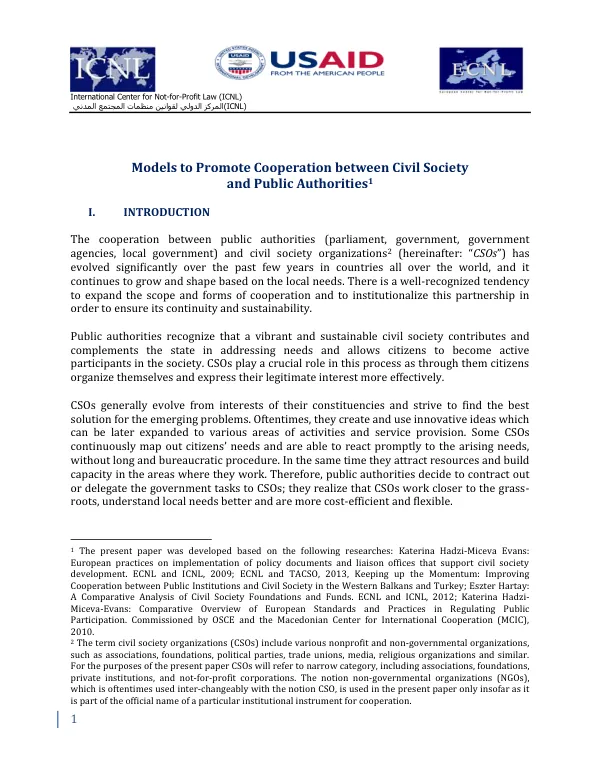
Models to Promote Cooperation between Civil Society and Public Authorities
The cooperation between public authorities and civil society organizations has evolved significantly over the past few years, with a growing tendency to expand the scope and forms of cooperation and to institutionalize this partnership in order to ensure its continuity and sustainability.
2013 · 16 pages
Sign in to readA free account is required to download.
Abstract
Public authorities recognize that a vibrant and sustainable civil society contributes and complements the state in addressing needs and allows citizens to become active participants in the society. Civil society organizations play a crucial role in shaping policies and laws and in promoting citizens' needs in those processes. The right of citizens to participate in the conduct of public affairs is one of the basic democratic principles that ensures that people can tackle problems that directly affect their lives. Citizen participation also enables authorities to carry out their competencies more efficiently. Civil society organizations are generally viewed as a bridge between citizens and public authorities, which help articulate the opinions of the concerned citizens more constructively. Public authorities have been supporting civil society organizations through enacting a favorable legal environment for establishment and sustainable operation. Enabling laws create a protective framework that limits the ability of governments to interfere with civil society basic rights and ensures that civil society organizations can carry out their roles and address the needs they aim to fulfill. An enabling legal framework creates strong, reliable partners in the civil sector and contributes towards the development of partnerships between civil society organizations and public authorities. There are six basic freedoms that civil society needs to operate, and the environment is considered enabling if there are no obstacles to their free enjoyment. These include the right to entry, the right to operate freely from state interference, the right to free expression, the right to communication and cooperation, the right to freedom of peaceful assembly, and the right to seek and secure resources. The precondition for all of this is the premise that "the state has a duty to protect," which also includes the obligation to ensure that the legislative framework related to fundamental freedom and civil society is enabling and the necessary institutional mechanisms are in place. Public authorities have been using various means to facilitate the development of the civil society sector and its participation in the policy-making process. These include policy documents for cooperation, government offices for cooperation, contact persons or departments for civil society organizations at ministerial level, contact persons in the parliament, councils for civil society development, other cross-sectoral advisory bodies focusing on specific areas or issues, civil society funds/foundations, and codes/regulations on citizen participation. In order to strengthen the cooperation and ensure longer-term partnerships, public authorities have adopted policy documents that provide a strategic framework for cooperation and set out the principles and rules of civil society involvement in policy and law-making processes.