USAID DEC
Molecular diagnostics of groundnut rosette disease agents in Uganda: Implications on epidemiology and management of groundnut rosette disease
Sign inUNIVERSITY OF MARYLAND
Molecular diagnostics of groundnut rosette disease agents in Uganda: Implications on epidemiology and management of groundnut rosette disease
Groundnut rosette disease (GRD) is a significant threat to groundnut production in sub-Saharan Africa, causing estimated annual losses of US$156 million.
2017 · 8 pages
Sign in to readA free account is required to download.
Abstract
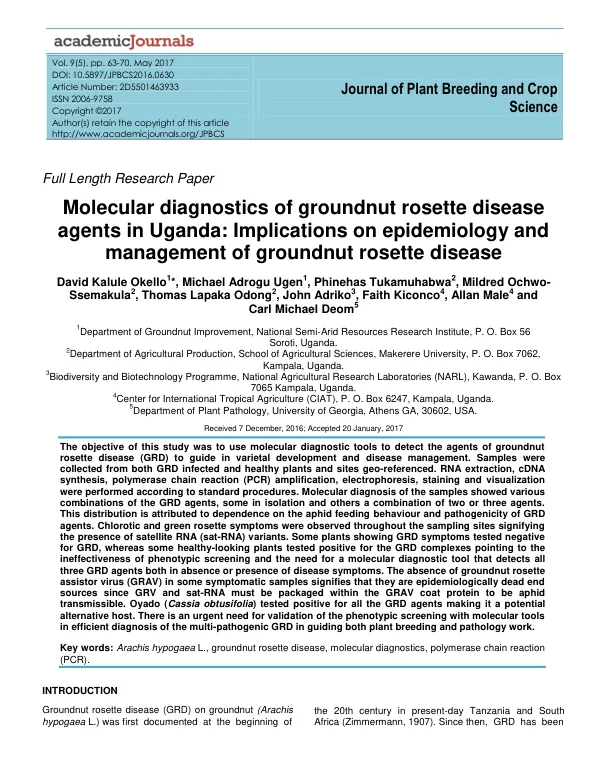
The disease is caused by synergistic interactions between two viruses and a satellite RNA - groundnut rosette assistor virus (GRAV), groundnut rosette virus (GRV), and a satellite RNA (sat-RNA) of GRV. The sat-RNA plays a crucial role in encapsidation of GRV RNA into GRAV coat protein and is required in aphid transmission. Chlorotic and green rosette symptoms were observed throughout the sampling sites, signifying the presence of satellite RNA (sat-RNA) variants. Some plants showing GRD symptoms tested negative for GRD, whereas some healthy-looking plants tested positive for the GRD complexes, pointing to the ineffectiveness of phenotypic screening. The absence of groundnut rosette assistor virus (GRAV) in some symptomatic samples signifies that they are epidemiologically dead-end sources since GRV and sat-RNA must be packaged within the GRAV coat protein to be aphid transmissible. Oyado (Cassia obtusifolia) tested positive for all the GRD agents, making it a potential alternative host. The study highlights the urgent need for validation of the phenotypic screening with molecular tools in efficient diagnosis of the multi-pathogenic GRD in guiding both plant breeding and pathology work. Molecular diagnostics of GRD agents can provide valuable insights into disease epidemiology and guide varietal development and management of the disease. The study employed molecular diagnostic tools to detect the agents of GRD in groundnut samples collected from both GRD-infected plants and symptomless samples. The samples were geo-referenced, and RNA extraction, cDNA synthesis, and polymerase chain reaction (PCR) amplification were performed according to standard procedures. The results showed various combinations of the GRD agents, some in isolation and others a combination of two or three agents, attributed to dependence on the aphid feeding behavior and pathogenicity of GRD agents. The study's findings have significant implications for the management of GRD in Uganda and other groundnut-growing regions of sub-Saharan Africa. The results highlight the need for efficient pathogen diagnostic systems, even in the absence of symptoms, to support breeding for GRD-resistant genotypes and their deployment. The study's molecular diagnostic approach can provide valuable insights into disease epidemiology and guide varietal development and management of the disease, ultimately contributing to improved groundnut yields and reduced economic losses.