USAID DEC
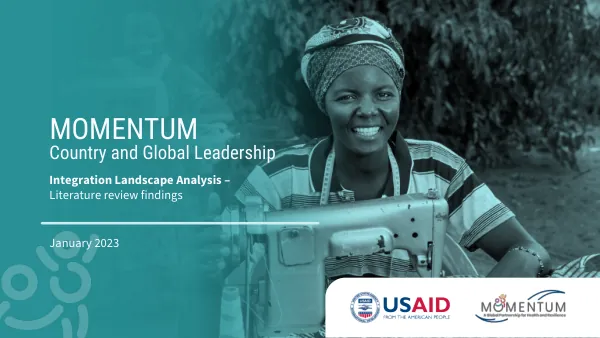
MOMENTUM Country and Global Leadership Integration Landscape Analysis – Literature review findings
Sign inUSAID DEC
MOMENTUM Country and Global Leadership Integration Landscape Analysis – Literature review findings
Primary Health Care Integration in Low- and Middle-Income Countries Primary health care integration in low- and middle-income countries (LMICs) is a complex issue, with various challenges and opportunities.
2023 · 30 pages
Sign in to readA free account is required to download.
Abstract
Health systems in LMICs face several challenges, including verticalization of services and fragmented approaches to service delivery at the frontlines. The need to integrate services and share resources between programs has been widely advocated. To address gaps in provider knowledge about integration, MOMENTUM proposed to develop a decision aid for integrating health services at the primary level in LMICs. However, an inadequate evidence base for developing this decision aid led to a pivot to a landscape analysis to understand primary health care integration in LMICs. This analysis consists of a literature review and case studies of four countries, including Nigeria, Madagascar, and Madagascar. The initial objective was to develop a decision aid for health workers; however, the paucity of information on the extent of integration in LMICs led to a change in direction. The objective of the landscape analysis is to provide evidence on the extent, benefits, barriers, and enablers of primary health service integration in LMICs to inform efforts to improve integration. The landscape analysis aims to understand the extent of clinical health care integration in LMICs, explore the benefits and risks to clinical integration, identify barriers and enabling factors for clinical integration, and identify solutions or approaches to solving challenges with clinical integration. To conduct the analysis, the analysis defined integration and defined integration as the management and delivery of health services so that individuals receive a continuum of health services coordinated across different sites of care and according to their needs throughout the life course. The analysis examined clinical integration in terms of place, discipline, and systems. Clinical integration refers to the coordination of person-centered care in a single setting across time, place, and discipline. Professional integration refers to interprofessional partnerships based on shared competences, roles, responsibilities, and accountability to deliver a comprehensive continuum of care to a defined population. Organizational integration refers to the inter-organizational relationships, common governance mechanisms, to deliver services to a defined population. System integration refers to the incorporation of vertical and horizontal integration to provide continuous, comprehensive, and coordinated services across the care continuum. The methodology for the analysis consisted of a systematic review of peer-reviewed and grey literature. The systematic review included peer-reviewed articles, grey literature, reports, policy documents, and guidelines. The peer-reviewed materials were sourced from four open-source databases, including Pubmed, JSTOR, Microsoft Academic, and Hinari. Grey literature materials were sourced from internet searches on Google and websites. The search terms used in the systematic review included "healthcare integration," "integration," "health coordination," "clinical integration," "extent of integration," "level," "dimension," "dimension in LMICs," "low-income countries," "middle-income countries," and "low- and middle-income countries." The team adopted a three-step process to collect data for the systematic review, including importing references, abstract screening, and full-text screening. The team used Covidence software to conduct the systematic review and screening.
Related documents