USAID DEC
MOMENTUM POLICY BRIEF - Promising Practices for Engaging Local Faith Actors to Promote Uptake of COVID-19 Vaccination
Sign inWORLD VISION
MOMENTUM POLICY BRIEF - Promising Practices for Engaging Local Faith Actors to Promote Uptake of COVID-19 Vaccination
Country and Global Leadership has identified a range of promising practices for engaging local faith actors (LFAs) to promote the uptake of COVID-19 vaccination in low- and middle-income countries (LMICs).
2021 · 9 pages
Sign in to readA free account is required to download.
Abstract
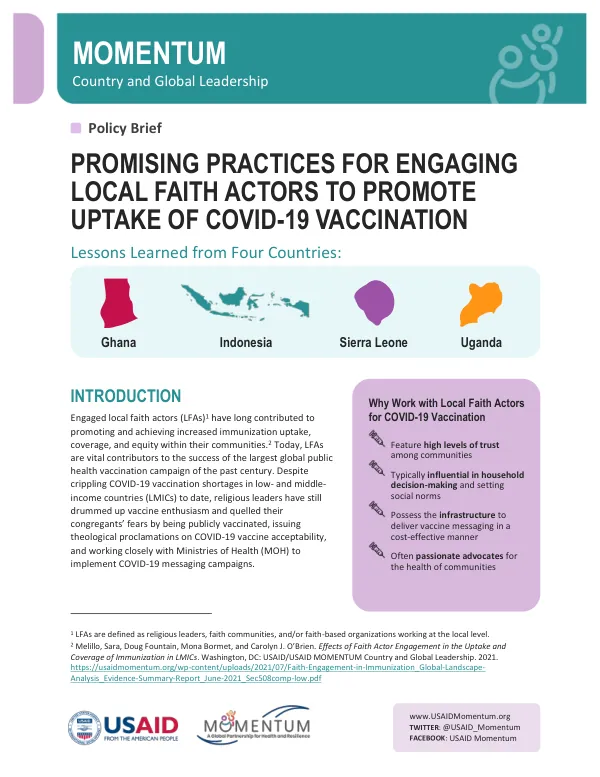
These practices are based on a qualitative review of experiences in four countries: Ghana, Indonesia, Sierra Leone, and Uganda. The review found that LFAs have the potential to significantly increase the acceptability, uptake, and coverage of COVID-19 vaccination in LMICs. LFAs are often influential in household decision-making and setting social norms, possess the infrastructure to deliver vaccine messaging in a cost-effective manner, and are passionate advocates for the health of communities. However, LFAs in many highly-religious LMICs are being under-supported and under-utilized for COVID-19 vaccination promotion and delivery by Ministries of Health (MOH), donors, and partners. The review identified 15 promising practices for engaging LFAs in the promotion of COVID-19 immunization. These practices are grouped into four major thematic buckets: high-level governance approaches, grassroots-level community interventions, strengthening support for COVID-19 immunization, and strengthening collaboration among LFAs and state and civil society actors. One promising practice is to engage in dialogue with religious leaders using traditional books/scripture, exploring the theological dimensions of specific antigens and linking COVID-19 interventions and vaccination to spiritual principles. For example, World Vision's Channels of Hope COVID-19 modules in Ghana and Sierra Leone provide a framework for engaging faith leaders and communities for COVID-19 vaccination, combining dialogue, analysis of religious texts, and exploring social norms to increase the adoption of vaccination. Another promising practice is to secure a theological blessing from religious leaders on the acceptability of COVID-19 vaccines and publicize that endorsement. For example, the Ulema Council in Indonesia declared the Sinovac COVID-19 vaccine halal in January 2021, paving the way for increased acceptability among the predominantly Muslim population. The review also found that creating virtual or in-person safe spaces where religious leaders can ask their questions about COVID-19 vaccination in a private or "closed" setting can be an effective approach. For example, FBO Muhammadiyah in Indonesia held "Zoominars" and online COVID-19 consultations with clerical bodies at subnational levels to hear their perceptions of the vaccine and share evidence-based information, reaching 1,500 religious leaders. Strengthening collaboration among LFAs and state and civil society actors on COVID-19 vaccination promotion and delivery is also a promising practice. For example, the Humanitarian Forum of Indonesia, a platform of 17 development FBOs, developed a COVID-19 Joint Response Plan and is working across its members to develop COVID-19 vaccination messaging. Overall, the review highlights the potential of LFAs to increase the acceptability, uptake, and coverage of COVID-19 vaccination in LMICs. By engaging LFAs in the promotion of COVID-19 immunization, Ministries of Health, donors, and partners can leverage their influence and infrastructure to reach more people and improve health outcomes.