USAID DEC
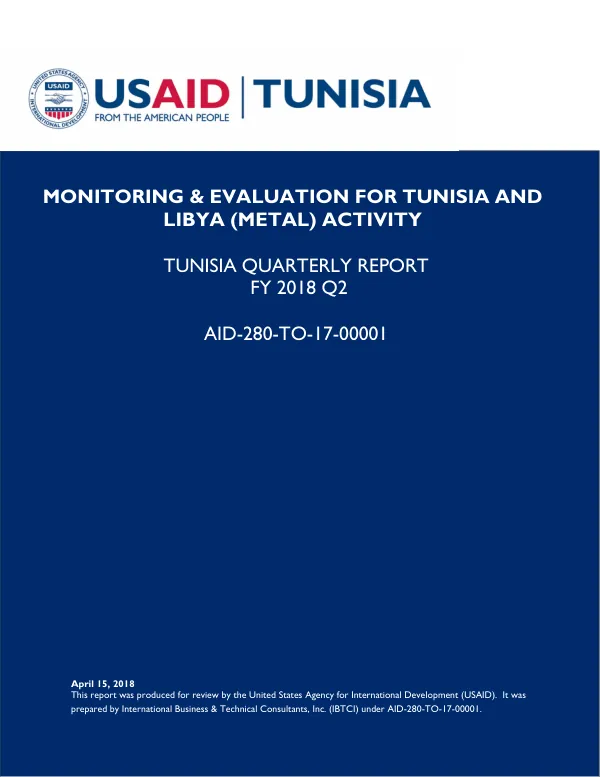
Monitoring and Evaluation for Tunisia and Libya (METAL) Activity, Tunisia Quarterly Report FY 2018 Q2
Sign inDELOITTE INC.
Monitoring and Evaluation for Tunisia and Libya (METAL) Activity, Tunisia Quarterly Report FY 2018 Q2
The Monitoring and Evaluation for Tunisia and Libya (METAL) activity is a technical support project for USAID/Tunisia and USAID/Libya.
2018 · 10 pages
Sign in to readA free account is required to download.
Abstract
The project aims to provide monitoring, evaluation, and learning services to support the achievement of the Country Development Cooperation Strategy (CDCS) goal and development objectives (DOs) for USAID/Tunisia, and to provide third-party monitoring and evaluation services for USAID/Libya. The METAL activity has two distinct branches, one for Tunisia and one for Libya. In Tunisia, the project will assist USAID/Tunisia in gaining and applying knowledge derived from monitoring, evaluation, and learning (MEL) to inform its program and strategy decisions. The project will also help strengthen the capacity of USAID/Tunisia and some of its local partners in monitoring, evaluation, and knowledge management. In Libya, the project will provide third-party monitoring and evaluation services, as well as support in efforts to gain and apply knowledge derived from MEL to inform program and strategy decisions. The METAL Indicator Tracking Table for Q2 FY2018 is attached to this report (Annex 1). The table provides an overview of the progress made by the implementing partners (IPs) in Tunisia and Libya during the second quarter of fiscal year 2018. Monitoring support was a key area of focus for the METAL activity in Q2 FY2018. The project worked with the IPs to harmonize and match their Activity Monitoring, Evaluation and Learning Plans (AMELPs) with the Performance Management Plan (PMP). The METAL team suggested the use of a template adopted by USAID/Lebanon, which was customized for Tunisia use and cleared by USAID and sent to the Contracting Officer's Representative (COR) for dissemination on March 28. The project also conducted introductory meetings with the IPs to present its scope of support and to initiate the assessment of monitoring capacities and review of IP AMELPs in accordance with the PMP Road Map. Meetings were held with TADAEEM - Deloitte and Mashrou3i - UNIDO, where the AMELP was reviewed and attendees had a thorough discussion related to the indicators and data quality assurance. The project has made significant progress in Q2 FY2018, including the harmonization and matching of IP AMELPs with the PMP, and the initiation of the assessment of monitoring capacities and review of IP AMELPs. The project will continue to work with the IPs to ensure that they have the necessary capacity and resources to implement effective monitoring and evaluation systems. The METAL activity has also identified several challenges and lessons learned during Q2 FY2018. The project has encountered challenges in working with the IPs to harmonize and match their AMELPs with the PMP, and in conducting the assessment of monitoring capacities and review of IP AMELPs. However, the project has also learned several lessons, including the importance of clear communication and coordination with the IPs, and the need for a flexible and adaptive approach to working with the IPs. The project plans to continue working with the IPs to ensure that they have the necessary capacity and resources to implement effective monitoring and evaluation systems. The project will also continue to provide technical support to the IPs to help them meet their monitoring and evaluation needs. The METAL activity has made significant progress in Q2 FY2018, and the project is on track to meet its objectives. The project will continue to work with the IPs to ensure that they have the necessary capacity and resources to implement effective monitoring and evaluation systems, and to provide technical support to the IPs to help them meet their monitoring and evaluation needs.