USAID DEC
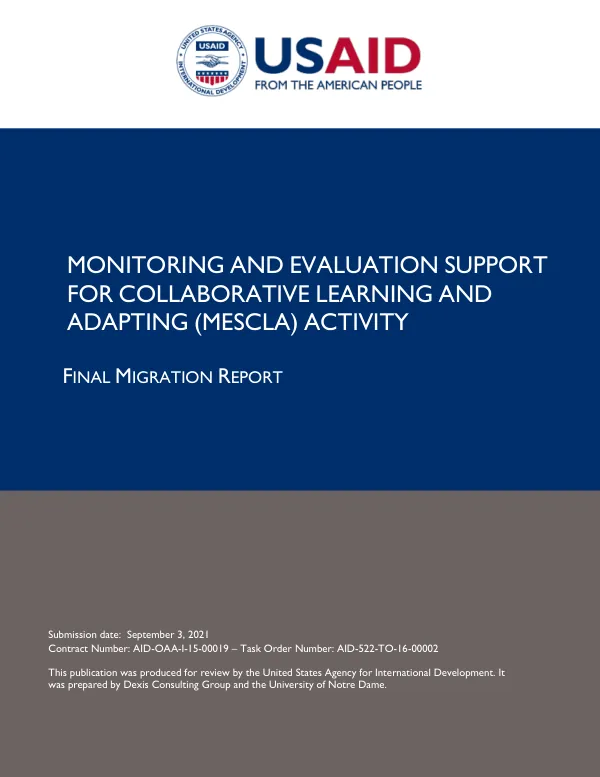
Monitoring and Evaluation Support for Collaborative Learning and Adapting (MESCLA) Activity Final Migration Report
Sign inECO CONSULTING GROUP
Monitoring and Evaluation Support for Collaborative Learning and Adapting (MESCLA) Activity Final Migration Report
The United States Agency for International Development (USAID)/Honduras Mission seeks to build its knowledge about the determinants and drivers of irregular migration to the U.S.
2021 · 53 pages
Sign in to readA free account is required to download.
Abstract
and to better understand how its portfolio affects these drivers. Since 2017, the Monitoring & Evaluation Support for Collaborative Learning and Adapting (MESCLA) Activity has supported the Mission in this task. The Activity has sought to help USAID/Honduras better understand the complex and intertwined drivers of migration, including economic challenges, high violence and insecurity, and weak institutions and impunity. Between the beginning of the Fiscal Year (FY) 2014 through June 2021, the Department of Homeland Security (DHS)/Customs and Border Protection (CBP) officials encountered approximately 800,000 Hondurans at the U.S. southwest border. From mid FY2018, there have been dramatic peaks and troughs in these numbers, with peaks characterized by high numbers of migrants traveling in family units. Family units were the largest category (52%) of encountered migrants for the period 2014-2021. Migrant profiles indicate that migrants encountered at the border are 40% female and 60% male, with an average age of 20 and 22 years respectively and a modal age range of 16-17. Returned migrants, however, are predominantly male, with an average age of 22 years, and few are under the age of 18. Most Hondurans encountered by U.S. authorities were apprehended after crossing the border, while a smaller share were deemed inadmissible at a port of entry. The determinants of migration are complex and multifaceted, involving a range of factors including international and national level factors, municipal level factors, income/poverty/occupation, drought, hurricanes, coffee price shocks, violence, migrant networks, education, citizen participation, democracy, and corruption. These factors interact and influence one another, contributing to the push and pull factors that drive migration. Research has identified several key drivers of migration, including economic challenges, high violence and insecurity, and weak institutions and impunity. Economic challenges, such as poverty and unemployment, are a major push factor, while high violence and insecurity, particularly in the form of gang violence and homicide, are a significant pull factor. Weak institutions and impunity, including corruption and lack of effective governance, also contribute to the drivers of migration. The Honduras Local Governance (HLG) program, implemented by USAID/Honduras, has sought to address some of these drivers by improving governance and reducing violence. The program has focused on strengthening local institutions, improving citizen participation, and reducing corruption. While the program has shown some positive results, including a reduction in homicide rates and an increase in citizen participation, more work is needed to address the complex and intertwined drivers of migration. The MESCLA Activity has also supported research on the impact of migration on the Honduran economy and society. Research has shown that migration has a significant impact on the Honduran economy, including a reduction in the labor force and a decrease in economic growth. However, migration also has a positive impact on the Honduran economy, including an increase in remittances and a reduction in poverty. In conclusion, the determinants of migration are complex and multifaceted, involving a range of factors that interact and influence one another. The MESCLA Activity has supported research on the drivers of migration, including economic challenges, high violence and insecurity, and weak institutions and impunity. The Honduras Local Governance program has sought to address some of these drivers by improving governance and reducing violence. More work is needed to address the complex and intertwined drivers of migration and to support USAID/Honduras's Country Development Cooperation Strategies (CDCSs).
Related documents