GLOBAL COMMUNITIES
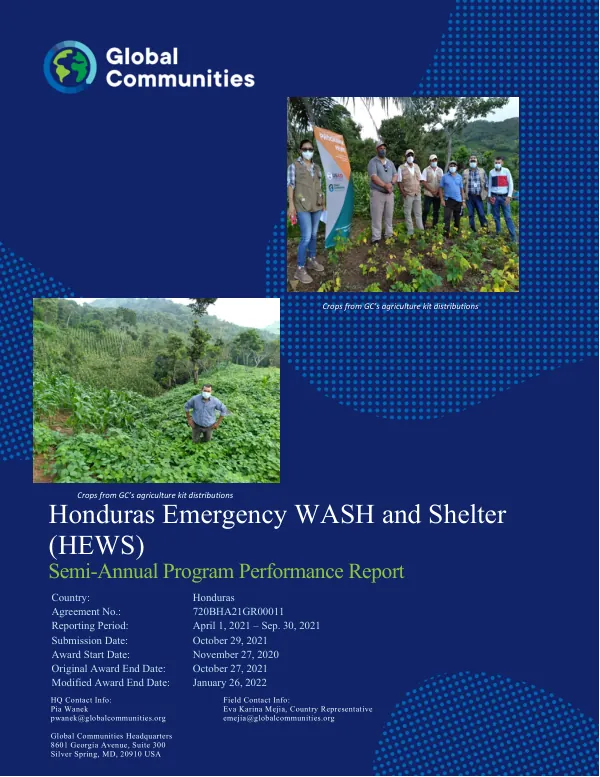
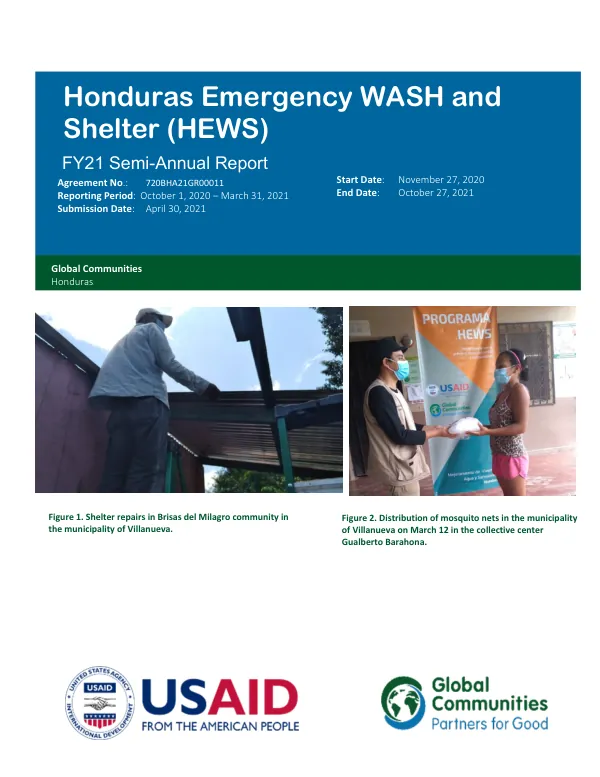
Honduras Emergency WASH and Shelter (HEWS) FY21 Semi-Annual Report
The Honduras Emergency WASH and Shelter (HEWS) program is a humanitarian initiative implemented by Global Communities (GC) in northwestern Honduras.
2021 · 30 pages
Sign in to readA free account is required to download.
Abstract
The program aims to address urgent shelter, WASH, and Multi-Purpose Cash Assistance (MPCA) needs of 54,000 vulnerable individuals affected by recent natural disasters, including Tropical Storms Eta and Iota. The program is funded by the Bureau for Humanitarian Assistance (BHA) and has a budget of $4.3 million. The HEWS program has three main objectives: Objective 1, which focuses on enabling approximately 2,300 families (11,500 individuals) to return to acceptable living conditions by ensuring access to safe, habitable, and appropriate emergency shelter and Shelter Non-Food Items (SNFIs); Objective 2, which aims to improve access to safe water supply, emergency sanitation facilities, and critically-needed WASH NFIs, deliver critical hygiene promotion messaging, and improve environmental health conditions for 54,000 disaster-affected people; and Objective 3, which seeks to empower 1,000 households to meet two months of basic needs through MPCA. During the first four months of program implementation, HEWS has supported 13,420 unique beneficiaries. The program has made significant progress in achieving its objectives, with 149 individuals enabled to return to acceptable living conditions, 12,965 individuals benefiting from improved access to safe water supply, emergency sanitation facilities, and WASH NFIs, and 306 households empowered to meet two months of basic needs through MPCA. Community and beneficiary selection is a critical component of the HEWS program. GC uses a rapid community selection process to identify communities for assistance, based on information collected by municipalities and corroborated through field visits. For household recovery activities, GC works closely with Municipal Emergency Committees (CODEMs) to prioritize communities for assistance, based on a standard set of selection criteria. GC conducts a technical assessment of each community identified in conjunction with CODEM to verify damage and other criteria. Beneficiary selection is also a critical component of the program. GC conducts household-level beneficiary selection for household recovery activities, to prioritize the most vulnerable households for early recovery activities. GC collects lists from patronatos and community-based organizations of the most vulnerable and affected households within each community and administers a beneficiary selection questionnaire to 100% of the people on the lists, as well as a random sample of other households in the community, to ensure that vulnerable households have not been excluded from the program. The HEWS program has made significant progress in achieving its objectives, with a strong focus on community and beneficiary selection. The program's success is a testament to the importance of effective community engagement and beneficiary selection in humanitarian response efforts.