USAID DEC
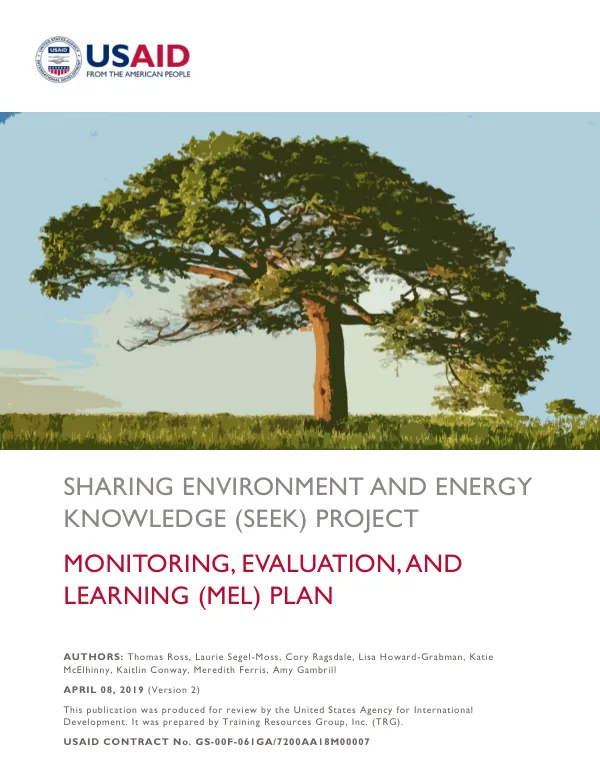
Monitoring, Evaluation, and Learning (MEL) Plan for the Sharing Environment and Energy Knowledge (SEEK) Project
Sign inTRAINING RESOURCES GROUP – TRG
Monitoring, Evaluation, and Learning (MEL) Plan for the Sharing Environment and Energy Knowledge (SEEK) Project
The Sharing Environment and Energy Knowledge (SEEK) project contributes to the Bureau of Economic Growth, Education and Environment's (E3) ongoing efforts to meet the U.S.
2019 · 27 pages
Sign in to readA free account is required to download.
Abstract
Agency for International Development's (USAID) objectives in training, communications, knowledge management and organizational development and facilitation. SEEK supports the work of four E3 offices: The Energy and Infrastructure (E&I) Office, Forestry and Biodiversity (FAB) Office, Global Climate Change (GCC) Office, and Water Office. The desired results of the project are to 1) provide USAID staff and the broader development community with the requisite knowledge, skills and abilities to design, implement, monitor and evaluate quality programs; 2) develop and enhance communications and information management systems that facilitate effective knowledge sharing and learning; 3) provide key audiences the information and knowledge needed to act with greater understanding of the offices' policies, programming, and impact; and 4) strengthen USAID's organizational capacity to efficiently learn and adaptively manage. The SEEK project builds directly on the activities and lessons learned from the Environmental Communications, Learning, and Outreach (ECO) project. The principles listed below were developed based on our learning under ECO and are fundamental principles that inform the SEEK MEL approach and guiding principles, as well as project- and activity-level implementation: Viewing learning as a continuum and incorporating a range of interventions leveraging training, KM, communications, and OD/facilitation for increased impact. Creating time to reflect, learn, and adapt to make sure we are understanding and meeting the evolving demands and needs of our audiences. Coordinating across and within SEEK offices to share and create efficiencies, ensuring we are not competing for resources (participants, venues, technical experts, etc.), and leveraging opportunities. Working collaboratively with SEEK team members, other implementing partners and other USAID offices to help the project be more efficient, strategic, and high-performing. The SEEK MEL approach emphasizes compliance and accountability while also developing the tools, processes, activities, and infrastructure that enable evidence-based office-level learning, collaboration, and adaptive management. This approach will be rooted at the office level, serving as a management tool to help USAID/W counterparts achieve their programmatic goals, underscoring a commitment to practicality and purpose. A key component of the MEL Plan will be to effectively capture, share, and manage knowledge across (and within) task areas and offices to better enable learning and inform decision-making. The SEEK project will work with designated counterparts from each of the four offices to identify priority learning questions that can inform decision-making and contribute to improved outcomes at the office and project level. We will leverage existing tools and processes and design new ones as needed to answer questions, communicate successes, and provide monitoring data for reporting. The MEL guiding principles include planning for purpose, informing as well as inspiring action, commitment to delivering engaging, well-designed products and events, including channels for feedback and engagement, encouraging cross-task area communication and collaboration, capturing and highlighting accomplishments, capturing and learning from challenges, more systematic capture, curation, and sharing of data, information, and resources, maintaining a "just right" level of effort, and serving as a backbone for learning and adaptive management, reinforcing project CLA. The SEEK project will improve upon the M&E protocol developed under ECO to continuously inform the design, development, and execution of learning programs so that they consistently address current and evolving technical needs, have the desired impact, and consider issues of cost effectiveness. The project will leverage existing tools and processes and design new ones as needed to answer questions, communicate successes, and provide monitoring data for reporting. The project will also work with designated counterparts from each of the four offices to identify priority learning questions that can inform decision-making and contribute to improved outcomes at the office and project level. The SEEK project will employ a range of evaluation approaches, including quantitative and qualitative methods, to assess the project's progress and impact. The project will also use a theoretical framework for monitoring and evaluation that is grounded in the principles of collaborative, learning, and adapting (CLA). This framework will guide the project's MEL activities and ensure that they are aligned with the project's goals and objectives. The project will also use a range of tools and processes to capture, share, and manage knowledge across (and within) task areas and offices to better enable learning and inform decision-making. The SEEK project will maintain a systematic and continuous approach to monitoring and evaluation, using a range of data collection and analysis methods to assess the project's progress and impact. The project will also use a range of tools and processes to capture, share, and manage knowledge across (and within) task areas and offices to better enable learning and inform decision-making. The project will also work with designated counterparts from each of the four offices to identify priority learning questions that can inform decision-making and contribute to improved outcomes at the office and project level.
Related documents